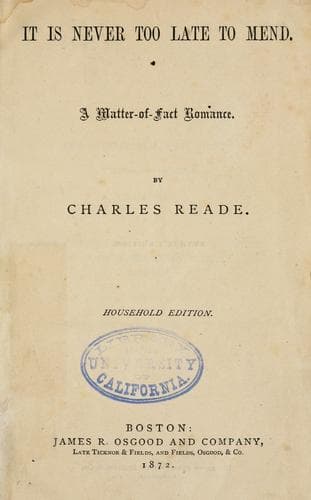
Great Britain -- Social conditions -- 19th century -- Fiction
“And will you forget awhile this unhappy quarrel and listen to my
words?”
“Surely I shall listen to you; for even now your voice is to my ear like
the wind sighing among the cedars of Lebanon, and the wave that plays at
night upon the sands of Galilee.”
“'Tis but the frail voice of a foolish woman, who loves and respects
you, and yet,” said Susan, her color mantling with enthusiasm, “with it
I can speak you words more beautiful than Lebanon's cedars or Galilee's
shore. Ay, old man, words that make the stars brighter and the sons
of the morning rejoice. I will not tell you whence I had them, but you
shall say surely they never came from earth, selfish, cruel, revengeful
earth, these words that drop on our hot passions like the dew, and speak
of trespasses forgiven, and peace and goodwill among men.”
Oh! magic of a lovely voice speaking the truths of Heaven! How still the
room was as these goodly words rang in it from a pure heart. Three men
there had all been raging with anger and hate; now a calming music fell
like oil upon these human waves, and stilled them.
The men drooped their heads, and held their breath to make sure the
balmy sounds had ceased. Then Levi answered in a tone gentle, firm, and
low (very different from his last), “Susanna, bitterness fades from my
heart as you speak; but experience remains.” He turned to Meadows, “When
I wander forth at Lady-day she shall still be watched over though I be
far away. My eye shall be here, and my hand shall still be so over you
all,” and raising his thin hand, he held it high up, the nails pointing
downward. It looked just like a hawk hovering over its prey. “I will
say no bitterer word than that to-day;” and in fact he delivered this
without apparent heat or malice.
“Come, then, with me, Susanna--a goodly name, it comes to you from the
despised people. Come like peace to my dwelling, Susanna--you know not
this world's wiles as I do, but you can teach me the higher wisdom that
controls the folly of passion and purifies the soul.”
The pair were gone, and William and Meadows were left alone. The latter
looked sadly and gloomily at the door by which Susan had gone out. He
was in a sort of torpor. He was not conscious of William's presence.
Now the said William had a misgiving; in the country a man's roof is
sacred; he had affronted Meadows under his own roof, and then Mr. Levi
had come and affronted him there, too. William began to doubt whether
this was not a little hard, moreover he thought he had seen Meadows
brush his eye hastily with the back of his hand as Susan retired. He
came toward Meadows with his old sulky, honest, hang-the-head manner,
and said, “Mr. Meadows, seems to me we have been a little hard upon you
in your own house, and I am not quite easy about my share on't.” Meadows
shrugged his shoulders imperceptibly.
Public-domain text, read in full here on John Shaqi.
Reviews
Reviews
No reviews yet
Be the first to share your thoughts on this work.
Elsewhere in the archive
Join the Discussion
Join the discussion
Sign in to leave a comment or review.
Sign InorCreate an account