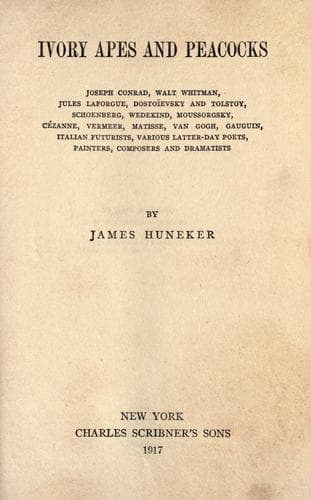
Art; Literature, Modern -- History and criticism; Music -- History and criticism
It is a pity that New York as yet has not had an opportunity of
viewing the best Cezannes, Gauguins, and Van Goghs. I did not see the
exhibition several years ago at the Armory, which was none the less an
eye-opener. But I have been told by those whose opinion and knowledge
are incontrovertible that this trinity of the modern movement was
inadequately represented; furthermore, Henri Matisse, a painter of
indubitable skill and originality, did not get a fair showing. It
would be a superfluous and thankless task to argue with critics or
artists who refuse to acknowledge Manet, Monet, Degas. These men are
already classics. Go to the Louvre and judge for yourself.
Impressionism has served its purpose; it was too personal in the case
of Claude Monet to be successfully practised by every one. Since him
many have hopelessly attempted the bending of his bow. Manet is an
incomplete Velasquez; but he is a great colourist, and interpreted in
his fluid, nervous manner the "modern" spirit. Degas, master designer,
whose line is as mighty as Ingres his master, is by courtesy
associated with the Impressionistic group, though his methods and
theirs are poles asunder. It seems that because he didn't imitate
Ingres in his choice of subject-matter he is carped at. To-day the
newest "vision" has reverted to the sharpest possible silhouettes and,
to add confusion, includes rhythms that a decade ago would not have
been thought possible.
II
I can't agree with those who call Paul Cezanne the "Nietzsche of
painting," because Nietzsche is brilliant and original while the
fundamental qualities of Cezanne are sincerity, a dogged sincerity,
and also splendid colouring--the value of the pigment in and for
itself, the strength and harmony of colour. His training was in the
classics. He knew Manet and Monet, but his personal temperament did
not incline him to their forms of Impressionism. A sober, calculating
workman, not a heaven-storming genius, yet a painter whose procedure
has served as a point of departure for the younger tribe. Like Liszt,
Cezanne is the progenitor of a school, for Wagner founded no great
school as much as he influenced his contemporaries; he was too
complete in himself to leave artistic descendants, and Liszt, an
intermediate type, influenced not only Wagner but the Russians and the
Neo-Frenchman. The greatest disciples of Cezanne are Gauguin and Van
Gogh. Mr. Brownell once wrote: "We only care for facts when they
explain truths," and the facts of Cezanne have that merit. He is
truthful to the degree of eliminating many important artistic factors
from his canvases. But he realises the bulk and weight of objects; he
delineates their density and profile. His landscapes and his humans
are as real as Manet's; he seeks to paint the actual, not the
relative. There is strength if not beauty--the old canonic beauty--and
in the place of the latter may be found rich colour. A master of
values, Cezanne.
Public-domain text, read in full here on John Shaqi.
Reviews
Reviews
No reviews yet
Be the first to share your thoughts on this work.
Elsewhere in the archive
Join the Discussion
Join the discussion
Sign in to leave a comment or review.
Sign InorCreate an account