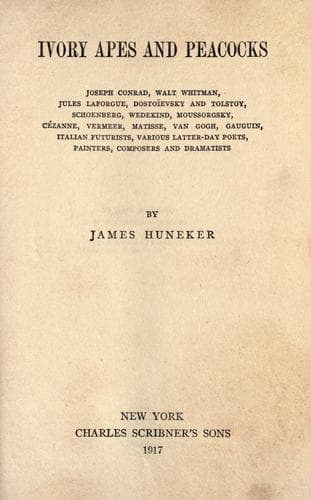
Art; Literature, Modern -- History and criticism; Music -- History and criticism
After all, paint is thicker than academic culture.
I saw the first Paul Gauguin exhibition at Durand-Ruel's in Paris
years ago. I recall contemporary criticism. "The figures are outlined
in firm strokes and painted in broad, flat tints on canvas that has
the texture of tapestry. Many of these works are made repulsive by
their aspect of multicoloured crude and barbarous imagery. Yet one
cannot but acknowledge the fundamental qualities, the lovely values,
the ornamental taste, and the impression of primitive animalism."
Since that rather faint praise Gauguin is aloft with the Olympians.
His art is essentially classic. Again his new themes puzzled critics.
A decorative painter born, he is fit for the company of Baudry the
eclectic, Moreau the symbolist, Puvis de Chavannes, greatest of modern
mural painters, and the starlit Besnard. A rolling stone was Gauguin,
one that gathered no stale moss. He saw with eyes that at Tahiti
became "innocent." The novelty of the flora and fauna there should not
be overlooked in this artistic recrudescence. His natural inclination
toward decorative subjects rekindled in the presence of the tropical
wilderness; at every step he discovered new motives. The very
largeness of the forms about him, whether human, vegetable, or floral,
appealed to his bold brush, and I think that critics should take this
into consideration before declaring his southern pictures garish. They
often seem so, but then the sunset there is glaring, the shadows
ponderous and full of harsh complementary reflects, while humanity
wears another aspect in this southern island where distance is
annihilated by the clarity of the atmosphere. No, Paul Gauguin is
certainly not a plagiarist. Clive Bell has written: "Great artists
never look back." I believe the opposite; all great artists look back
and from the past create a new synthesis.
Wells has said: "Better plunder than paralysis," the obverse of
Gauguin's teaching, and if Vincent Van Gogh "plundered" in his youth
it was not because he feared "paralysis." He merely practised his
scales in private before attempting public performance. Remember that
none of these revolutionary artists jumped overboard in the beginning
without swimming-bladders. They were all, and are all, men who have
served their technical apprenticeship before rebellion and complete
self-expression.
Public-domain text, read in full here on John Shaqi.
Reviews
Reviews
No reviews yet
Be the first to share your thoughts on this work.
Elsewhere in the archive
Join the Discussion
Join the discussion
Sign in to leave a comment or review.
Sign InorCreate an account