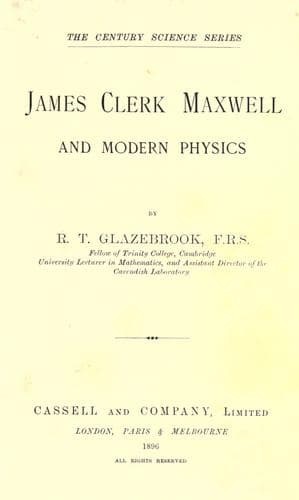
James Clerk Maxwell and Modern PhysicsGlazebrook, Richard
History
James Clerk Maxwell and Modern Physics
Glazebrook, Richard
Maxwell, James Clerk, 1831-1879; Physics -- History
“It appears, therefore, that certain phenomena in electricity
and magnetism lead to the same conclusion as those of optics,
namely, that there is an ætherial medium pervading all bodies,
and modified only in degree by their presence; that the parts
of this medium are capable of being set in motion by electric
currents and magnets; that this motion is communicated from
one part of the medium to another by forces arising from the
connection of those parts; that under the action of these
forces there is a certain yielding depending on the elasticity
of these connections; and that, therefore, energy in two
different forms may exist in the medium, the one form being
the actual energy of motion of its parts, and the other being
the potential energy stored up in the connections in virtue of
their elasticity.
“Thus, then, we are led to the conception of a complicated
mechanism capable of a vast variety of motion, but at the
same time so connected that the motion of one part depends,
according to definite relations, on the motion of other parts,
these motions being communicated by forces arising from the
relative displacement of the connected parts, in virtue of
their elasticity. Such a mechanism must be subject to the
general laws of dynamics, and we ought to be able to work out
all the consequences of its motion, provided we know the form
of the relation between the motions of the parts.”
These general laws of dynamics, applicable to the motion of any
connected system, had been developed by Lagrange, and are expressed
in his generalised equations of motion. It is one of Maxwell’s chief
claims to fame that he saw in the electric field a connected system to
which Lagrange’s equations could be applied, and that he was able to
deduce the mechanical and electrical actions which take place by means
of fundamental propositions of dynamics.
The methods of the paper now under discussion were developed further
in the “Treatise on Electricity and Magnetism,” published in 1873; in
endeavouring to give some slight account of Maxwell’s work, we shall
describe it in the form it ultimately took.
The task which Maxwell set himself was a double one; he had first to
express in symbols, in as general a form as possible, the fundamental
laws of electro-magnetism as deduced from experiments, chiefly
the experiments of Faraday, and the relations between the various
quantities involved; when this was done he had to show how these laws
could be deduced from the general dynamical laws applicable to any
system of moving bodies.
Public-domain text, read in full here on John Shaqi.
Reviews
Reviews
No reviews yet
Be the first to share your thoughts on this work.
Elsewhere in the archive
Join the Discussion
Join the discussion
Sign in to leave a comment or review.
Sign InorCreate an account