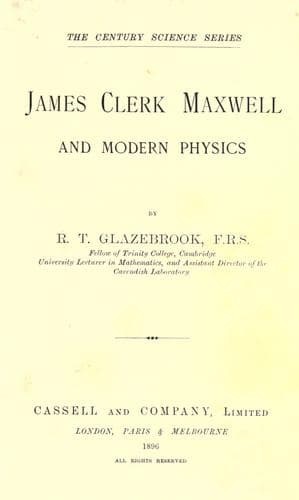
James Clerk Maxwell and Modern PhysicsGlazebrook, Richard
History
James Clerk Maxwell and Modern Physics
Glazebrook, Richard
Maxwell, James Clerk, 1831-1879; Physics -- History
There are two classes of phenomena, electric and magnetic, which have
been known from very early times, and which are connected together.
When a piece of sealing-wax is rubbed it is found to attract other
bodies, it is said to exert electric force throughout the space
surrounding it; when two different metals are dipped in slightly
acidulated water and connected by a wire, certain changes take place
in the plates, the water, the wire, and the space round the wire,
electric force is again exerted and a current of electricity is said
to flow in the wire. Again, certain bodies, such as the lodestone, or
pieces of iron and steel which have been treated in a certain manner,
exhibit phenomena of action at a distance: they are said to exert
magnetic force, and it is found that this magnetic force exists in the
neighbourhood of an electric current and is connected with the current.
Again, when electric force is applied to a body, the effects may be in
part electrical, in part mechanical; the electrical state of the body
is in general changed, while in addition, mechanical forces tending to
move the body are set up. Experiment must teach us how the electrical
state depends on the electric force, and what is the connection
between this electric force and the magnetic forces which may, under
certain circumstances, be observed. Now, in specifying the electric
and magnetic conditions of the system, various other quantities, in
addition to the electric force, will have to be introduced; the first
step is to formulate the necessary quantities, and to determine the
relations between them and the electric force.
Consider now a wire connecting the two poles of an electric battery--in
its simplest form, a piece of zinc and a piece of copper in a vessel
of dilute acid--electric force is produced at each point of the wire.
Let us suppose this force known; an electric current depending on the
material and the size of the wire flows along it, its value can be
determined at each point of the wire in terms of the electric force
by Ohm’s law. If we take either this current or the electric force
as known, we can determine by known laws the electric and magnetic
conditions elsewhere. If we suppose the wire to be straight and very
long, then, so long as the current is steady and we neglect the small
effect due to the electrostatic charge on the wire, there is no
electric force outside the wire. There is, however, magnetic force,
and it is found that the lines of magnetic force are circles round the
wire. It is found also that the work done in travelling once completely
round the wire against the magnetic force is measured by the current
flowing through the wire, and is obtained in the system of units
usually adopted by multiplying the current by 4π. This last result then
gives us one of the necessary relations, that between the magnetic
force due to a current and the strength of the current.
Public-domain text, read in full here on John Shaqi.
Reviews
Reviews
No reviews yet
Be the first to share your thoughts on this work.
Elsewhere in the archive
Join the Discussion
Join the discussion
Sign in to leave a comment or review.
Sign InorCreate an account