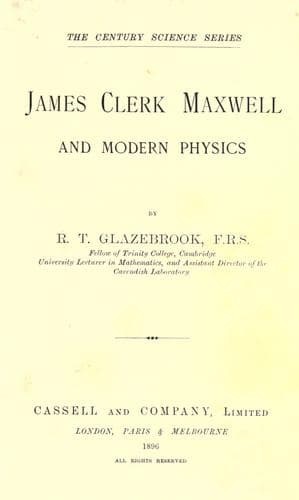
James Clerk Maxwell and Modern PhysicsGlazebrook, Richard
History
James Clerk Maxwell and Modern Physics
Glazebrook, Richard
Maxwell, James Clerk, 1831-1879; Physics -- History
Maxwell assumes that the crystalline character of the dielectric can
be sufficiently represented by supposing the inductive capacity to
be different in different directions; experiments have since shewn
that this is true for crystals such as Iceland Spar and Aragonite;
he assumes also, and this, too, is justified by experiment, that the
magnetic permeability does not depend on the direction. It follows
from these assumptions that a crystal will produce double refraction
and polarisation of electric waves which fall upon it, and, further,
that the laws of double refraction will be those given by Fresnel for
light waves in a doubly refracting medium. There will be two waves in
the crystal. The disturbance in each of these will be plane polarised;
their velocity and the position of their plane of polarisation can be
found from the direction in which they are travelling by Fresnel’s
construction exactly.
Maxwell’s theory, then, would appear to indicate some close connection
between electric waves and those of light. Faraday’s experiments on
the rotation of the plane of polarisation by magnetic force shew one
phenomenon in which the two are connected, and Maxwell endeavoured to
apply his theory to explain this. Here, however, it became necessary
to introduce an additional hypothesis--there must be some connection
between the motion of the ether to which magnetic force is due and that
which constitutes light. It is impossible to give a mechanical account
of the rotation of the plane of polarisation without some assumption as
to the relation between these two kinds of motion. Maxwell, therefore,
supposes the linear displacements of a point in the ether to be those
which give rise to light, while the components of the magnetic force
are connected with these in the same way as the components of a vortex
in a liquid in vortex motion are connected with the displacements of
the liquid. He further assumes the existence of a term of special form
in the expression for the kinetic energy, and from these assumptions he
deduces the laws of the propagation of polarised light in a magnetic
field. These laws agree in the main with the results of Verdet’s
experiments.
CHAPTER X.
DEVELOPMENT OF MAXWELL’S THEORY.
We have endeavoured in the preceding pages to give some account of
Maxwell’s contributions to electrical theory and the physics of the
ether. We must now consider very briefly what evidence there is to
support these views. At Maxwell’s death such evidence, though strong,
was indirect. His supporters were limited to some few English-speaking
pupils, young and enthusiastic, who were convinced, it may be, in no
small measure, by the affection and reverence with which they regarded
their master. Abroad his views had made very little way.
In the last words of his book he writes, speaking of various
distinguished workers--
Public-domain text, read in full here on John Shaqi.
Reviews
Reviews
No reviews yet
Be the first to share your thoughts on this work.
Elsewhere in the archive
Join the Discussion
Join the discussion
Sign in to leave a comment or review.
Sign InorCreate an account