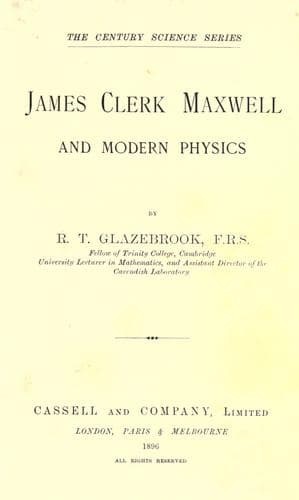
James Clerk Maxwell and Modern PhysicsGlazebrook, Richard
History
James Clerk Maxwell and Modern Physics
Glazebrook, Richard
Maxwell, James Clerk, 1831-1879; Physics -- History
“There appears to be in the minds of these eminent men some
prejudice, or _à priori_ objection, against the hypothesis
of a medium in which the phenomena of radiation of light and
heat, and the electric actions at a distance, take place. It
is true that, at one time, those who speculated as to the
causes of physical phenomena were in the habit of accounting
for each kind of action at a distance by means of a special
ætherial fluid, whose function and property it was to produce
these actions. They filled all space three and four times over
with æthers of different kinds, the properties of which were
invented merely to ‘save appearances,’ so that more rational
enquirers were willing rather to accept not only Newton’s
definite law of attraction at a distance, but even the dogma
of Cotes,[64] that action at a distance is one of the primary
properties of matter, and that no explanation can be more
intelligible than this fact. Hence the undulatory theory of
light has met with much opposition, directed not against its
failure to explain the phenomena, but against its assumption of
the existence of a medium in which light is propagated.
“We have seen that the mathematical expression for
electro-dynamic action led, in the mind of Gauss, to the
conviction that a theory of the propagation of electric
action in time would be found to be the very key-stone of
electro-dynamics. Now we are unable to conceive of propagation
in time, except either as the flight of a material substance
through space, or as the propagation of a condition of motion,
or stress, in a medium already existing in space.
“In the theory of Neumann, the mathematical conception called
potential, which we are unable to conceive as a material
substance, is supposed to be projected from one particle to
another in a manner which is quite independent of a medium,
and which, as Neumann has himself pointed out, is extremely
different from that of the propagation of light.
“In the theories of Riemann and Betti it would appear that the
action is supposed to be propagated in a manner somewhat more
similar to that of light.
Public-domain text, read in full here on John Shaqi.
Reviews
Reviews
No reviews yet
Be the first to share your thoughts on this work.
Elsewhere in the archive
Join the Discussion
Join the discussion
Sign in to leave a comment or review.
Sign InorCreate an account