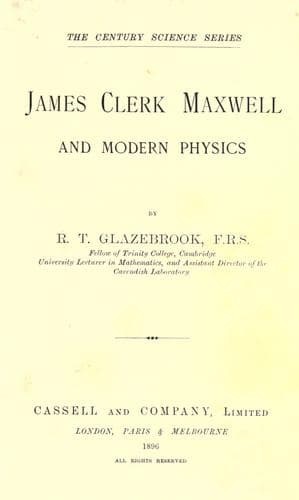
James Clerk Maxwell and Modern PhysicsGlazebrook, Richard
History
James Clerk Maxwell and Modern Physics
Glazebrook, Richard
Maxwell, James Clerk, 1831-1879; Physics -- History
“Casting now a glance backwards, we see that by the experiments
above sketched the propagation in time of a supposed action
at a distance is for the first time proved. This fact forms
the philosophic result of the experiments, and indeed, in a
certain sense, the most important result. The proof includes
a recognition of the fact that the electric forces can
disentangle themselves from material bodies, and can continue
to subsist as conditions or changes in the state of space. The
details of the experiments further prove that the particular
manner in which the electric force is propagated exhibits the
closest analogy[70] with the propagation of light; indeed, that
it corresponds almost completely to it. The hypothesis that
light is an electrical phenomenon is thus made highly probable.
To give a strict proof of this hypothesis would logically
require experiments upon light itself.
“What we here indicate as having been accomplished by the
experiments is accomplished independently of the correctness
of particular theories. Nevertheless, there is an obvious
connection between the experiments and the theory in connection
with which they were really undertaken. Since the year 1861
science has been in possession of a theory which Maxwell
constructed upon Faraday’s views, and which we therefore call
the Faraday-Maxwell theory. This theory affirms the possibility
of the class of phenomena here discovered just as positively
as the remaining electrical theories are compelled to deny
it. From the outset Maxwell’s theory excelled all others in
elegance and in the abundance of the relations between the
various phenomena which it included.
“The probability of this theory, and therefore the number of
its adherents, increased from year to year. But as long as
Maxwell’s theory depended solely upon the probability of its
results, and not on the certainty of its hypotheses, it could
not completely displace the theories which were opposed to it.
“The fundamental hypotheses of Maxwell’s theory contradicted
the usual views, and did not rest upon the evidence of decisive
experiments. In this connection we can best characterise the
object and the result of our experiments by saying: The object
of these experiments was to test the fundamental hypotheses of
the Faraday-Maxwell theory, and the result of the experiments
is to confirm the fundamental hypotheses of the theory.”
Public-domain text, read in full here on John Shaqi.
Reviews
Reviews
No reviews yet
Be the first to share your thoughts on this work.
Elsewhere in the archive
Join the Discussion
Join the discussion
Sign in to leave a comment or review.
Sign InorCreate an account