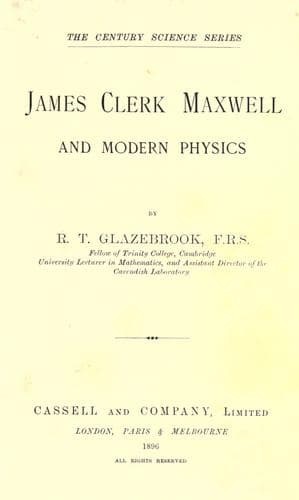
James Clerk Maxwell and Modern PhysicsGlazebrook, Richard
History
James Clerk Maxwell and Modern Physics
Glazebrook, Richard
Maxwell, James Clerk, 1831-1879; Physics -- History
“If you can find out any people in Edinburgh who do not see
colours (I know the Dicksons don’t), pray drop a hint that
I would like to see them. I have put one here up to a dodge
by which he distinguishes colours without fail. I have also
constructed a pair of squinting spectacles, and am beginning
operations on a squinting man.”
A paper written for his own use originally some time in 1854, but
communicated as a parting gift to his friend Farrar, who was about to
become a master at Marlborough, gives us some insight into his view of
life at the age of twenty-three.
“He that would enjoy life and act with freedom must have the
work of the day continually before his eyes. Not yesterday’s
work, lest he fall into despair; nor to-morrow’s, lest he
become a visionary--not that which ends with the day, which is
a worldly work; nor yet that only which remains to eternity,
for by it he cannot shape his actions.
“Happy is the man who can recognise in the work of to-day a
connected portion of the work of life and an embodiment of
the work of Eternity. The foundations of his confidence are
unchangeable, for he has been made a partaker of Infinity. He
strenuously works out his daily enterprises because the present
is given him for a possession.
“Thus ought Man to be an impersonation of the divine process
of nature, and to show forth the union of the infinite with
the finite, not slighting his temporal existence, remembering
that in it only is individual action possible; nor yet shutting
out from his view that which is eternal, knowing that Time is
a mystery which man cannot endure to contemplate until eternal
Truth enlighten it.”
His father was unwell in the Christmas vacation of that year, and he
could not return to Cambridge at the beginning of the Lent term. “My
steps,” he writes[20] to C. J. Munro from Edinburgh, February 19th,
1855, “will be no more by the reedy and crooked till Easter term.... I
should like to know how many kept bacalaurean weeks go to each of these
terms, and when they begin and end. Overhaul the Calendar, and when
found make note of.”
He was back in Cambridge for the May term, working at the motion
of fluids and at his colour-top. A paper on “Experiments on Colour
as Perceived by the Eye” was communicated to the Royal Society of
Edinburgh on March 19th, 1855. The experiments were shown to the
Cambridge Philosophical Society in May following, and the results are
thus described in two letters[21] to his father, Saturday, May 5th,
1855:
Public-domain text, read in full here on John Shaqi.
Reviews
Reviews
No reviews yet
Be the first to share your thoughts on this work.
Join the Discussion
Join the discussion
Sign in to leave a comment or review.
Sign InorCreate an account