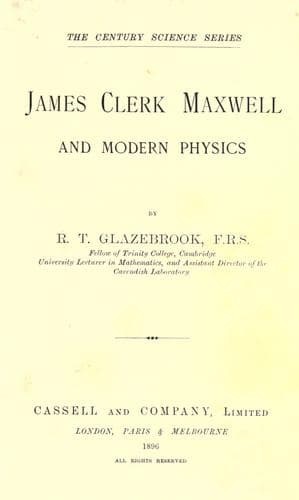
James Clerk Maxwell and Modern PhysicsGlazebrook, Richard
History
James Clerk Maxwell and Modern Physics
Glazebrook, Richard
Maxwell, James Clerk, 1831-1879; Physics -- History
The two results of this theory which seemed to lend themselves most
readily to experimental verification were (1) that the viscosity of
a gas is independent of its density, and (2) that it is proportional
to the square root of the absolute temperature. The next piece
of work connected with the theory was an attempt to test these
consequences, and a description of the experiments was published in the
“Philosophical Transactions” for 1865, in a paper on the “Viscosity
or Internal Friction of Air and other Gases,” and forms the Bakerian
lecture for that year.
The first result was completely proved. It is shewn that the value of
the coefficient[51] of viscosity “is the same for air at 0·5 inch and
at 30 inches pressure, provided that the temperature remains the same.”
It was clear also that the viscosity depended on the temperature,
and the results of the experiments seemed to show that it was nearly
proportional to the absolute temperature. Thus for two temperatures,
185° Fah. and 51° Fah., the ratio of the two coefficients found was
1·2624; the ratio of the two temperatures, each measured from absolute
zero, is 1·2605.
This result, then, does not agree with the hypothesis that a gas
consists of spherical molecules acting only on each other by a kind of
impact, for, if this were so, the coefficient would, as we have seen,
depend on the square root of the absolute temperature. But Maxwell’s
result, connecting viscosity with the first power of the absolute
temperature, has not been confirmed by other investigators. According
to it we should have as the relation between μ, the coefficient of
viscosity at t° and μ₀, that at zero the equation--
μ = μ₀ (1 + .00365 t).
The most recent results of Professor Holman (_Philosophical Magazine_,
Vol. xxi., p. 212) give--
μ = μ₀ (1 + .00275 t - .00000034 t²).
And results similar to this are given by O. E. Meyer, Puluj, and
Obermeyer. Maxwell’s coefficient ·00365 is too large, but ·00182, the
coefficient obtained by supposing the viscosity proportional to the
square root of the temperature, would be too small.
It still remains true, therefore, that the laws of the viscosity of
gases cannot be explained by the hypothesis of the impact of hard
spheres; but some deductions drawn by Maxwell in his next paper from
his supposed law of proportionality to the first power of the absolute
temperature require modification.
It was clear from his experiments just described that the simple
hypothesis of the impact of elastic bodies would not account for all
the phenomena observed. Accordingly, in 1866, Maxwell took up the
problem in a more general form in his paper on the “Dynamical Theory of
Gases,” Phil. Trans., 1866.
Public-domain text, read in full here on John Shaqi.
Reviews
Reviews
No reviews yet
Be the first to share your thoughts on this work.
Elsewhere in the archive
Join the Discussion
Join the discussion
Sign in to leave a comment or review.
Sign InorCreate an account