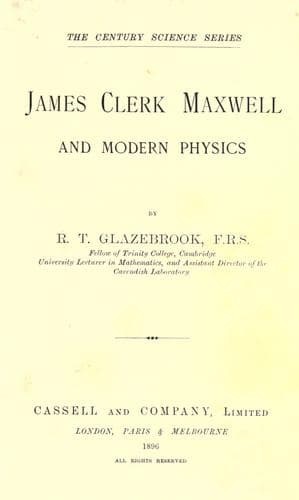
James Clerk Maxwell and Modern PhysicsGlazebrook, Richard
History
James Clerk Maxwell and Modern Physics
Glazebrook, Richard
Maxwell, James Clerk, 1831-1879; Physics -- History
“The present state of electrical science seems peculiarly
unfavourable to speculation. The laws of the distribution of
electricity on the surface of conductors have been analytically
deduced from experiment; some parts of the mathematical
theory of magnetism are established, while in other parts the
experimental data are wanting; the theory of the conduction of
galvanism, and that of the mutual attraction of conductors,
have been reduced to mathematical formulæ, but have not
fallen into relation with the other parts of the science. No
electrical theory can now be put forth, unless it shows the
connection, not only between electricity at rest and current
electricity, but between the attractions and inductive effects
of electricity in both states. Such a theory must accurately
satisfy those laws, the mathematical form of which is known,
and must afford the means of calculating the effects in the
limiting cases where the known formulæ are inapplicable.
In order, therefore, to appreciate the requirements of the
science, the student must make himself familiar with a
considerable body of most intricate mathematics, the mere
retention of which in the memory materially interferes with
further progress. The first process, therefore, in the
effectual study of the science, must be one of simplification
and reduction of the results of previous investigation to a
form in which the mind can grasp them. The results of this
simplification may take the form of a purely mathematical
formula or of a physical hypothesis. In the first case we
entirely lose sight of the phenomena to be explained; and
though we may trace out the consequences of given laws, we can
never obtain more extended views of the connections of the
subject. If, on the other hand, we adopt a physical hypothesis,
we see the phenomena only through a medium, and are liable
to that blindness to facts and rashness in assumption which
a partial explanation encourages. We must therefore discover
some method of investigation which allows the mind at every
step to lay hold of a clear physical conception, without being
committed to any theory founded on the physical science from
which that conception is borrowed, so that it is neither drawn
aside from the subject in pursuit of analytical subtleties, nor
carried beyond the truth by a favourite hypothesis.
Public-domain text, read in full here on John Shaqi.
Reviews
Reviews
No reviews yet
Be the first to share your thoughts on this work.
Elsewhere in the archive
Join the Discussion
Join the discussion
Sign in to leave a comment or review.
Sign InorCreate an account