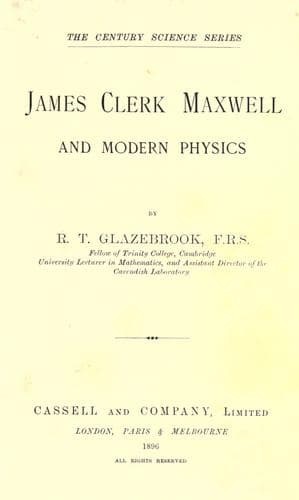
James Clerk Maxwell and Modern PhysicsGlazebrook, Richard
History
James Clerk Maxwell and Modern Physics
Glazebrook, Richard
Maxwell, James Clerk, 1831-1879; Physics -- History
“In this way we might find a line passing through any point
of space, such that it represents the direction of the
force acting on a positively electrified particle, or on an
elementary north pole, and the reverse direction of the force
on a negatively electrified particle or an elementary south
pole. Since at every point of space such a direction may be
found, if we commence at any point and draw a line so that,
as we go along it, its direction at any point shall always
coincide with that of the resultant force at that point, this
curve will indicate the direction of that force for every point
through which it passes, and might be called on that account a
_line of force_. We might in the same way draw other lines of
force, till we had filled all space with curves indicating by
their direction that of the force at any assigned point.
“We should thus obtain a geometrical model of the physical
phenomena, which would tell us the _direction_ of the force,
but we should still require some method of indicating the
_intensity_ of the force at any point. If we consider these
curves not as mere lines, but as fine tubes of variable section
carrying an incompressible fluid, then, since the velocity of
the fluid is inversely as the section of the tube, we may make
the velocity vary according to any given law, by regulating the
section of the tube, and in this way we might represent the
intensity of the force as well as its direction by the motion
of the fluid in these tubes. This method of representing the
intensity of a force by the velocity of an imaginary fluid in
a tube is applicable to any conceivable system of forces, but
it is capable of great simplification in the case in which
the forces are such as can be explained by the hypothesis of
attractions varying inversely as the square of the distance,
such as those observed in electrical and magnetic phenomena.
In the case of a perfectly arbitrary system of forces, there
will generally be interstices between the tubes; but in the
case of electric and magnetic forces it is possible to arrange
the tubes so as to leave no interstices. The tubes will then be
mere surfaces, directing the motion of a fluid filling up the
whole space. It has been usual to commence the investigation of
the laws of these forces by at once assuming that the phenomena
are due to attractive or repulsive forces acting between
certain points. We may, however, obtain a different view of the
subject, and one more suited to our more difficult inquiries,
by adopting for the definition of the forces of which we treat,
that they may be represented in magnitude and direction by the
uniform motion of an incompressible fluid.
Public-domain text, read in full here on John Shaqi.
Reviews
Reviews
No reviews yet
Be the first to share your thoughts on this work.
Elsewhere in the archive
Join the Discussion
Join the discussion
Sign in to leave a comment or review.
Sign InorCreate an account