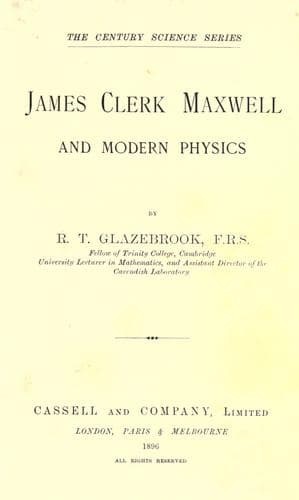
James Clerk Maxwell and Modern PhysicsGlazebrook, Richard
History
James Clerk Maxwell and Modern Physics
Glazebrook, Richard
Maxwell, James Clerk, 1831-1879; Physics -- History
“I propose, then, first to describe a method by which the
motion of such a fluid can be clearly conceived; secondly
to trace the consequences of assuming certain conditions of
motion, and to point out the application of the method to some
of the less complicated phenomena of electricity, magnetism,
and galvanism; and lastly, to show how by an extension of these
methods, and the introduction of another idea due to Faraday,
the laws of the attractions and inductive actions of magnets
and currents may be clearly conceived, without making any
assumptions as to the physical nature of electricity, or adding
anything to that which has been already proved by experiment.
“By referring everything to the purely geometrical idea of the
motion of an imaginary fluid, I hope to attain generality and
precision, and to avoid the dangers arising from a premature
theory professing to explain the cause of the phenomena.
If the results of mere speculation which I have collected
are found to be of any use to experimental philosophers, in
arranging and interpreting their results, they will have served
their purpose, and a mature theory, in which physical facts
will be physically explained, will be formed by those who by
interrogating Nature herself can obtain the only true solution
of the questions which the mathematical theory suggests.”
The idea was a bold one: for a youth of twenty-three to explain, by
means of the motions of an incompressible fluid, some of the less
complicated phenomena of electricity and magnetism, to show how
the laws of the attractions of magnets and currents may be clearly
conceived without making any assumption as to the physical nature of
electricity, or adding anything to that which has already been proved
by experiment.
It may be useful to review in a very few words the position of
electrical theory[57] in 1855.
Coulomb’s experiments had established the fundamental facts of
electrostatic attraction and repulsion, and Coulomb himself, about
1785, had stated a theory based on these experiments which could “only
be attacked by proving his experimental results to be inaccurate.”[58]
Coulomb supposes the existence of two electric fluids, the theory
developed previously by Franklin, but says--
“Je préviens pour mettre la théorie qui va suivre à l’abri de
toute dispute systématique, que dans la supposition de deux
fluides électriques, je n’ai autre intention que de présenter
avec le moins d’éléments possible les résultats du calcul et
de l’expérience, et non d’indiquer les véritables causes de
l’électricité.”
Cavendish was working in England about the same time as Coulomb, but
he published very little, and the value and importance of his work
was not recognised until the appearance in 1879 of the “Electrical
Researches of Henry Cavendish,” edited by Clerk Maxwell.
Public-domain text, read in full here on John Shaqi.
Reviews
Reviews
No reviews yet
Be the first to share your thoughts on this work.
Elsewhere in the archive
Join the Discussion
Join the discussion
Sign in to leave a comment or review.
Sign InorCreate an account