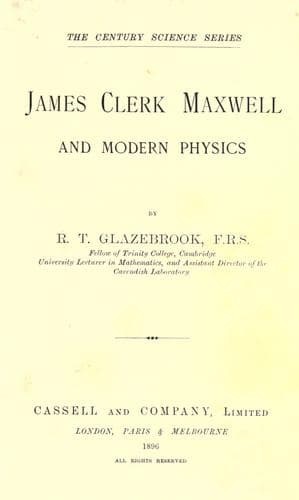
James Clerk Maxwell and Modern PhysicsGlazebrook, Richard
History
James Clerk Maxwell and Modern Physics
Glazebrook, Richard
Maxwell, James Clerk, 1831-1879; Physics -- History
Early in the present century the application of mathematical analysis
to electrical problems was begun by Laplace, who investigated the
distribution of electricity on spheroids, and about 1811 Poisson’s
great work on the distribution of electricity on two spheres placed
at any given distance apart was published. Meanwhile the properties
of the electric current were being investigated. Galvani’s discovery
of the muscular contraction in a frog’s leg, caused by the contact of
dissimilar metals, was made in 1790. Volta invented the voltaic pile in
1800, and Oersted in 1820 discovered that an electric current produced
magnetic force in its neighbourhood. On this Ampère laid the foundation
of his theory of electro-dynamics, in which he showed how to calculate
the forces between circuits carrying currents from an assumed law of
force between each pair of elements of the circuits. His experiments
proved that the consequences which follow from this law are consistent
with all the observed facts. They do not prove that Ampère’s law alone
can explain the facts.
Maxwell, writing on this subject in the “Electricity an Magnetism,”
vol. ii., p. 162, says--
“The experimental investigation by which Ampère established the
laws of the mechanical action between electric currents is one
of the most brilliant achievements in science.
“The whole, theory and experiment, seems as if it had leaped
full grown and full armed from the brain of the ‘Newton
of Electricity.’ It is perfect in form and unassailable in
accuracy, and it is summed up in a formula from which all the
phenomena may be deduced, and which must always remain the
cardinal formula of electro-dynamics.
“The method of Ampère, however, though cast into an inductive
form, does not allow us to trace the formation of the ideas
which guided it. We can scarcely believe that Ampère really
discovered the law of action by means of the experiments which
he describes. We are led to suspect, what, indeed, he tells us
himself, that he discovered the law by some process which he
has not shown us, and that when he had afterwards built up a
perfect demonstration, he removed all traces of the scaffolding
by which he had built it.”
Public-domain text, read in full here on John Shaqi.
Reviews
Reviews
No reviews yet
Be the first to share your thoughts on this work.
Elsewhere in the archive
Join the Discussion
Join the discussion
Sign in to leave a comment or review.
Sign InorCreate an account