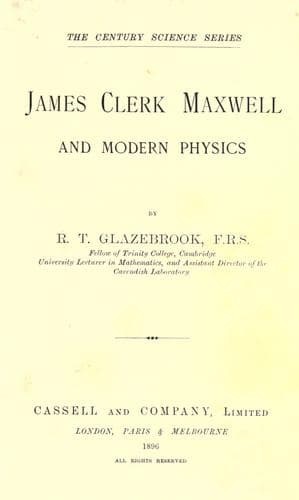
James Clerk Maxwell and Modern PhysicsGlazebrook, Richard
History
James Clerk Maxwell and Modern Physics
Glazebrook, Richard
Maxwell, James Clerk, 1831-1879; Physics -- History
“All the views which Faraday has brought forward and
illustrated, as demonstrated by experiment, lead to this method
of establishing the mathematical theory, and, as far as the
analysis is concerned, it would in most _general_ propositions
be more simple, if possible, than that of Coulomb. Of course
the analysis of _particular_ problems would be identical in the
two methods. It is thus that Faraday arrives at a knowledge of
some of the most important of the mathematical theorems which
from their nature seemed destined never to be perceived except
as mathematical truths.”
Lord Kelvin’s papers on “The Mathematical Theory of Electricity,”
published from 1848 to 1850, his “Propositions on the Theory of
Attraction” (1842), his “Theory of Electrical Images” (1847), and his
paper on “The Mathematical Theory of Magnetism” (1849), contain a
statement of the most important results achieved in the mathematical
sciences of Electrostatics and Magnetism up to the time of Maxwell’s
first paper.
The opening sentences of that paper have already been quoted. In the
preface to the “Electricity and Magnetism” Maxwell writes thus:--
“Before I began the study of electricity I resolved to read
no mathematics on the subject till I had first read through
‘Experimental Researches on Electricity.’ I was aware that
there was supposed to be a difference between Faraday’s way of
conceiving phenomena and that of the mathematicians, so that
neither he nor they were satisfied with each other’s language.
I had also the conviction that this discrepancy did not arise
from either party being wrong. I was first convinced of this by
Sir William Thomson, to whose advice and assistance, as well as
to his published papers, I owe most of what I have learned on
the subject.
“As I proceeded with the study of Faraday, I perceived that his
method of conceiving the phenomena was also a mathematical
one, though not exhibited in the conventional form of
mathematical symbols. I also found that these methods were
capable of being expressed in the ordinary mathematical forms,
and thus compared with those of the professed mathematicians.
“For instance, Faraday, in his mind’s eye, saw lines of force
traversing all space where the mathematicians saw centres of
force attracting at a distance. Faraday saw a medium where
they saw nothing but distance. Faraday sought the seat of the
phenomena in real actions going on in the medium. They were
satisfied that they had found it in a power of action at a
distance impressed on the electric fluids.”
Public-domain text, read in full here on John Shaqi.
Reviews
Reviews
No reviews yet
Be the first to share your thoughts on this work.
Elsewhere in the archive
Join the Discussion
Join the discussion
Sign in to leave a comment or review.
Sign InorCreate an account