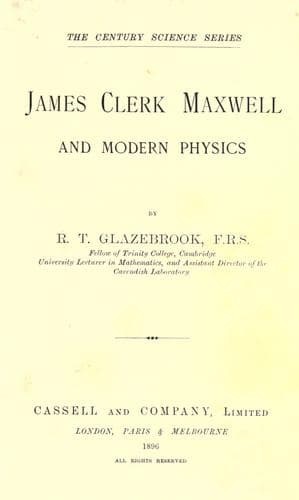
James Clerk Maxwell and Modern PhysicsGlazebrook, Richard
History
James Clerk Maxwell and Modern Physics
Glazebrook, Richard
Maxwell, James Clerk, 1831-1879; Physics -- History
Now, Maxwell saw an analogy between electrostatics and the steady
motion of an incompressible fluid like water, and it is this analogy
which he develops in the first part of his paper. The water flows along
definite lines; a surface which consists wholly of such lines of flow
will have the property that no water ever crosses it. In any stream
of water we can imagine a number of such surfaces drawn, dividing it
up into a series of tubes; each of these will be a tube of flow, each
of these tubes remain always filled with water. Hence, the quantity
of water which crosses per second any section of a tube of flow
perpendicular to its length is always the same. Thus, from the form of
the tube, we can obtain information as to the direction and strength of
the flow, for where the tube is wide the flow will be proportionately
small, and _vice versâ_.
Again, we can draw in the fluid a number of surfaces, over each of
which the pressure is the same; these surfaces will cut the tubes
of flow at right angles. Let us suppose they are drawn so that the
difference of pressure between any two consecutive surfaces is unity,
then the surfaces will be close together at points at which the
pressure changes rapidly; where the variation of pressure is slow, the
distance between two consecutive surfaces will be considerable.
If, then, in any case of motion, we can draw the pressure surfaces,
and the tubes of flow, we can determine the motion of the fluid
completely. Now, the same mathematical expressions which appear in
the hydro-dynamical theory occur also in the theory of electricity,
the meaning only of the symbols is changed. For velocity of fluid we
have to write electrical force. For difference of fluid pressure we
substitute work done, or difference of electrical potential or pressure.
The surfaces and tubes, drawn as the solution of any hydro-dynamical
problem, give us also the solution of an electrical problem; the
tubes of flow are Faraday’s tubes of force, or tubes of induction,
the surfaces of constant pressure are surfaces of equal electrical
potential. Induction may take place in curved lines just as the tubes
of flow may be bent and curved; the analogy between the two is a
complete one.
But, as Maxwell shows, the analogy reaches further still. An electric
current flowing along a wire had been recognised as having many
properties similar to those of a current of liquid in a tube. When a
steady current is passing through any solid conductor, there are formed
in the conductor tubes of electrical flow and surfaces of constant
pressure. These tubes and surfaces are the same as those formed by the
flow of liquid through a solid whose boundary surface is the same
as that of the conductor, provided the flow of liquid is properly
proportioned to the flow of electricity.
Public-domain text, read in full here on John Shaqi.
Reviews
Reviews
No reviews yet
Be the first to share your thoughts on this work.
Elsewhere in the archive
Join the Discussion
Join the discussion
Sign in to leave a comment or review.
Sign InorCreate an account