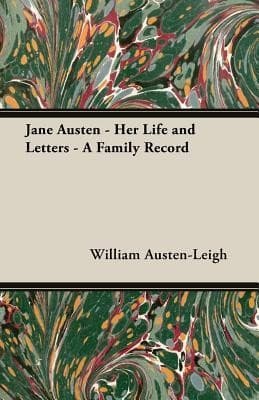
Jane Austen, Her Life and Letters: A Family Record — John Shaqi
Jane Austen, Her Life and Letters: A Family RecordAusten-Leigh, William
General
Jane Austen, Her Life and Letters: A Family Record
Austen-Leigh, William
Austen, Jane, 1775-1817; Austen, Jane, 1775-1817 -- Family; Novelists, English -- 19th century -- Family relationships
Elizabeth Weller, a woman happily cast in a different mould from her
husband, was an ancestress of Jane Austen who deserves commemoration.
Thrifty, energetic, a careful mother, and a prudent housewife, she
managed, though receiving only grudging assistance from the Austen
family, to pay off her husband's debts, and to give to all her younger
children a decent education at a school at Sevenoaks; the eldest boy
(the future squire) being taken off her hands by his grandfather.[6]
Elizabeth left behind her not only elaborately kept accounts but also a
minute description of her actions through many years and of the motives
which governed them. It may be interesting to quote one sentence
relating to her move from Horsmonden to Sevenoaks for the sake of her
children's education. 'These considerations with y^{e} tho'ts of having
my own boys in y^{e} house, with a good master (as all represented him
to be) were y^{e} inducements that brought me to Sen'nock, for it seemed
to me as if I cou'd not do a better thing for my children's good, their
education being my great care, and indeed all I think I was capable of
doing for 'em, for I always tho't if they had learning, they might get
better shift in y^{e} world, with w^{t} small fortune was alloted 'em.'
When the good mother died in 1721, her work was done. Schooldays were
over, the daughter married, and the boys already making their way in the
world.
The young squire and his son held gentle sway at Broadford through the
eighteenth century; but much more stirring and able was the next
brother, Francis. He became a solicitor. Setting up at Sevenoaks 'with
eight hundred pounds and a bundle of pens,' he contrived to amass a very
large fortune, living most hospitably, and yet buying up all the
valuable land round the town which he could secure, and enlarging his
means by marrying two wealthy wives. But his first marriage did not take
place till he was nearer fifty than forty; and he had as a bachelor been
a most generous benefactor to the sons of his two next brothers, Thomas
and William.
His second wife, who became in due course of time godmother to her
great-niece, Jane Austen, was the widow of Samuel Lennard, of West
Wickham, who left her his estate. Legal proceedings ensued over the
will, and Mrs. Lennard took counsel of Francis Austen, who ended by
winning both the case and her hand. Francis's son by his first wife
(known as Motley Austen) rounded off the family estate at Sevenoaks by
purchasing the Kippington property. Motley's third son, John, eventually
inherited the Broadford estate. Francis's two most distinguished
descendants were Colonel Thomas Austen of Kippington, well known as M.P.
for Kent, and the Rev. John Thomas Austen, senior wrangler in 1817.
Public-domain text, read in full here on John Shaqi.
Reviews
Reviews
No reviews yet
Be the first to share your thoughts on this work.
Join the Discussion
Join the discussion
Sign in to leave a comment or review.
Sign InorCreate an account