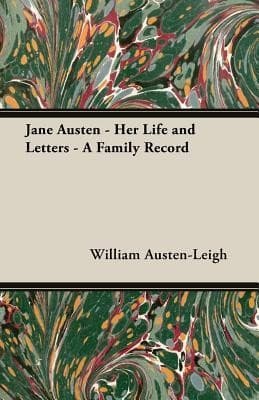
Jane Austen, Her Life and Letters: A Family RecordAusten-Leigh, William
General
Jane Austen, Her Life and Letters: A Family Record
Austen-Leigh, William
Austen, Jane, 1775-1817; Austen, Jane, 1775-1817 -- Family; Novelists, English -- 19th century -- Family relationships
The Walter family settled in Lincolnshire, where they have held Church
preferment, and have also been well known in the world of sport. Phila's
brother James seems to have been at the same time an exemplary parson,
beloved by his flock, and also a sort of 'Jack Russell,' and is said to
have met his death in the hunting-field, by falling into a snow-drift,
at the age of eighty-four. His son Henry distinguished himself in a more
academical manner. He was second wrangler in 1806, and a Fellow of St.
John's. Nor was he only a mathematician; for in June 1813 Jane Austen
met a young man named Wilkes, an undergraduate of St. John's, who spoke
very highly of Walter as a scholar; he said he was considered the best
classic at Cambridge. She adds: 'How such a report would have interested
my father!' Henry Walter was at one time tutor at Haileybury, and was
also a beneficed clergyman. He was known at Court; indeed, it is said
that, while he declined higher preferment for himself, he was consulted
by George IV and William IV on the selection of bishops.
The wife that George Austen chose belonged to the somewhat large clan of
the Leighs of Adlestrop in Gloucestershire, of which family the
Leighs[7] of Stoneleigh were a younger branch. Her father was the Rev.
Thomas Leigh, elected Fellow of All Souls at so early an age that he was
ever after called 'Chick Leigh,' and afterwards Rector of Harpsden, near
Henley.
Both these branches of the Leigh family descended from Sir Thomas Leigh,
Lord Mayor of London, behind whom Queen Elizabeth rode to be proclaimed
at Paul's Cross. He was rich enough and great enough to endow more than
one son with estates; but while the elder line at Adlestrop remained
simple squires, the younger at Stoneleigh rose to a peerage. The latter
branch, however, were now rapidly approaching extinction, while the
former had many vigorous scions. The family records have much to say of
one of the squires--Theophilus (who died in 1724), the husband of Mary
Brydges and the father of twelve children, a strong character, and one
who lived up to fixed, if rather narrow, ideas of duty. We hear of his
old-fashioned dress and elaborate bows and postures, of his affability
to his neighbours, and his just, though somewhat strict, government of
his sons. It is difficult to picture to oneself a set of modern Oxford
men standing patiently after dinner, in the dining-parlour, as
Theophilus's sons did, 'till desired to sit down and drink Church and
King.' Meanwhile, his brother-in-law, the Duke of Chandos (the patron of
Handel), used to send for the daughters to be educated in the splendour
of Canons (his place in Middlesex), and to make such matches as he chose
for them with dowries of L3000 a-piece.
Cassandra's father, Thomas, was the fourth son of Theophilus Leigh. An
older and better known brother was another Theophilus, Master of Balliol
for more than half a century.
Public-domain text, read in full here on John Shaqi.
Reviews
Reviews
No reviews yet
Be the first to share your thoughts on this work.
Join the Discussion
Join the discussion
Sign in to leave a comment or review.
Sign InorCreate an account