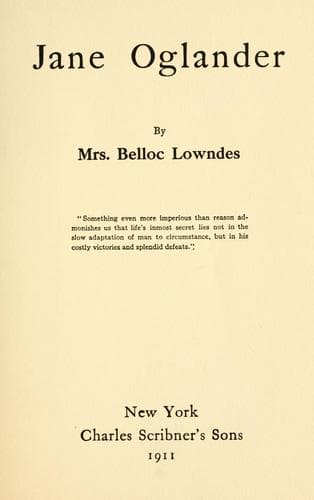
Country homes -- Fiction; England -- Social life and customs -- Fiction; Man-woman relationships -- Fiction
When he was not writing, this man--whose name, by the way, was Ryecroft,
and whose misfortune it was to be temperamentally incapable of
sustained, wage-earning work--spent many hours walking about the London
streets studying the human side of London's traffic, and especially that
side which to a certain type of observer, of saunterer in the labyrinth,
is full of ever recurring mystery and charm. He wrote of the depths,
because the depths were all he knew, with an intimate and a terrible
knowledge. But he had your true romancer's craving for romance, and his
eager face with its curiously high, straight forehead crowned with a
shock of rather long auburn hair, was the face and head of the idealist,
of the humourist, and--now that he is dead, why not say so?--of the
lover, of the man that is to whom the most interesting thing in the
world remains, when all is said and done,--woman, and man's pursuit, not
necessarily conquest, of the elusive creature.
Ryecroft had been already on Westminster Bridge for some time before he
became aware that a feminine figure of more than common distinction and
interest, a young lady whose appearance and light buoyant step sharply
differentiated her from those about her, was walking toward him. As he
saw her his eyes lighted up with a rather pathetic pleasure, and in an
instant he had become sensitively aware of every detail of her dress.
She wore a plain grey coat and skirt, and a small hat of which the
Mercury wings, to the whimsical fellow watching her, evoked the Hellas
of his dreams. A black and white spotted veil, which, as was then the
fashion, left the wearer's delicately cut sensitive mouth bare, shadowed
her hazel eyes.
Ryecroft noticed--he always saw such things--that the young lady wore
odd gloves, the one on her right hand was light grey, that clothing her
left moleskin in colour. The trifling fact pleased him. It showed, or so
he argued with himself, that this sweet stranger had a soul above the
usual pernickety vanities of young womanhood.
For a moment their eyes met, and he admired the gentle, not unkind
indifference with which she received his eager, measuring glance.
In a sense, Jane Oglander never saw at all the man who was gazing at her
so intently, and he never saw her again, but for some moments--perhaps
for as long as half an hour--this singular and gifted being felt himself
to be in sensitive, even close, sympathy with her, and in his emotional
memory she henceforth occupied a niche labelled "The Lady of Westminster
Bridge."
Ryecroft allowed Miss Oglander to pass by him, and then quietly and very
unobtrusively he followed her; stopping when she stopped, following the
direction of her eyes, trying as far as might be to think her thoughts,
and meanwhile weaving in his mind a portrait of her having as little
relation to reality as has a woodland scene in tapestry to a real sun
and shadow-filled glade.
Public-domain text, read in full here on John Shaqi.
Reviews
Reviews
No reviews yet
Be the first to share your thoughts on this work.
Join the Discussion
Join the discussion
Sign in to leave a comment or review.
Sign InorCreate an account