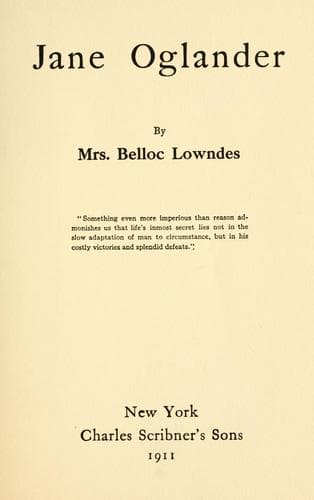
Country homes -- Fiction; England -- Social life and customs -- Fiction; Man-woman relationships -- Fiction
When she reached the end of the bridge, after looking to the right and
to the left, the young lady walked across the roadway with an assured
step, and Ryecroft's eager, sensitive face brightened. This was in the
picture, the picture he had drawn and coloured with his own pigments.
"For this kind of young Englishwoman the traffic stops instinctively of
itself," he said to himself; "and she has no fear of being run over"
(perhaps it should be added, that this little one-sided adventure of
Henry Ryecroft's took place before the advent of the trams). And still
he followed, keeping close behind her. Suddenly she turned toward the
Underground Railway, and this annoyed him; he had hoped that she (and
he) would walk down Great George Street, across the two parks, and so
into old Mayfair.
As an alternative he had promised himself the pleasure of seeing her get
into a hansom-cab. Were she to disappear into the ugly gulf of the
Underground it would disappoint him unreasonably. But stop! She had
turned her back on the cavernous entrance to the station and she was
gazing down at the posters of the evening papers.
The placards were all emblazoned with the same piece of news,
differently worded: "General Lingard in London," "Reception of Lingard
at Victoria," "Return of a Famous Soldier."
Ryecroft's lip curled. He had an intellectual contempt for the fighting
man as such, and a horror, nay a loathing, of war. He knew what even a
brief and successful war means to those among whom his own lot was cast,
the London woman whose son, whose brother, whose lover is so often
called Thomas Atkins.
And now, at last, he heard his lady's voice. She beckoned to the
smallest and most ragged of the lads selling newspapers:--
"I want all to-night's papers:" her voice fell with an agreeable cadence
on Ryecroft's ears. He was singularly susceptible to the cadences of the
human voice, and he thought he had never heard a sweeter. She took a
shilling out of her purse, and, rather to his surprise, he saw that her
purse was small, black and worn.
"How much?" she asked gently.
The boy hesitated, and then answered, "Five-pence halfpenny."
She handed him a shilling. "You can keep the change," she said, and a
very charming smile quivered across her face, "for yourself."
The man who was watching her felt touched--unreasonably moved. "Thank
God," he said to himself, "that, unlike many of her friends, she has
nothing to do with the C.O.S.!"
Then to Ryecroft's surprise, instead of going on as he expected her to
do--he had already made up his mind that she was taking the papers home
to an invalid father, or to a brother who had hurt himself in one of
those mad games in which, as the watcher knew well, the young English
oligarch delights to spend his spare time--the young lady turned, and
crossed over again on to the bridge, but this time she chose the other
side, the side which commands the more beautiful view of the London
river.
Public-domain text, read in full here on John Shaqi.
Reviews
Reviews
No reviews yet
Be the first to share your thoughts on this work.
Join the Discussion
Join the discussion
Sign in to leave a comment or review.
Sign InorCreate an account