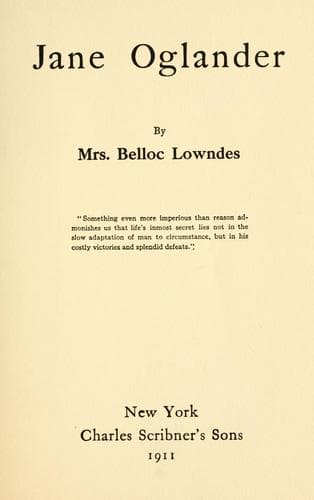
Country homes -- Fiction; England -- Social life and customs -- Fiction; Man-woman relationships -- Fiction
Friends had rallied--too many rather than too few--round the unfortunate
girl; but her best friends, those to whom she felt she owed the
greatest gratitude, were a certain Richard Maule, one of the trustees
of her small fortune, and Richard Maule's wife, Athena.
Mr. Maule, at the time of the tragedy already an invalid, had been able
to do nothing in an active sense, but his country house, Rede Place, had
immediately become, whenever she chose that it should be so, Miss
Oglander's home. In this matter the husband and wife were one in a sense
they had scarcely ever been, but in the happy, cloudless days which now
seemed to have belonged to a former existence, Jane Oglander had already
become as much as a young girl can be to a married woman some years
older than herself, Mrs. Maule's closest friend.
With these two dear friends was joined in the same wordless sense of
deep gratitude Dick Wantele, Richard Maule's cousin, and in this affair
his spokesman and representative.
It was this young man who, shaking himself free of a constitutional
lethargy, had become the indispensable adviser and friend of both
brother and sister; it was he who had persuaded Jack Oglander to plead
"not guilty"; it was he who had gone to great personal trouble in order
that Miss Oglander might be spared, as much as was possible, the
dreadful publicity into which each such tragic happening brings innocent
victims.
During the weeks which elapsed between the arrest and the trial, Miss
Oglander learnt to lean on Dick Wantele, to ask for, and defer to, his
advice, far more than she was at the time aware. Wantele's tact and good
feeling, and his intelligent withholding of the sympathy with which she
was at that time nauseated, were almost uncannily clever considering the
end he had in view.
An offer of marriage very seldom takes a woman by surprise, but twice
Jane Oglander was so surprised immediately after her brother's arrest.
The very next day a man much older than herself--whom she had regarded
with the kindly affection and indifference with which girls so often
regard one whom they unconsciously consider as a contemporary of their
parents rather than their own--had come and implored her to marry him
there and then. He was a member of the administration then in office,
and he had hinted that by doing this--that is, by marrying him--she
would almost certainly benefit her brother's cause. But though she was
touched, and touched to tears, by the strangely worded proposal, it
formed but an incident, to herself an unimportant incident, in days
crowded with such pain and amazing unhappiness.
Public-domain text, read in full here on John Shaqi.
Reviews
Reviews
No reviews yet
Be the first to share your thoughts on this work.
Join the Discussion
Join the discussion
Sign in to leave a comment or review.
Sign InorCreate an account