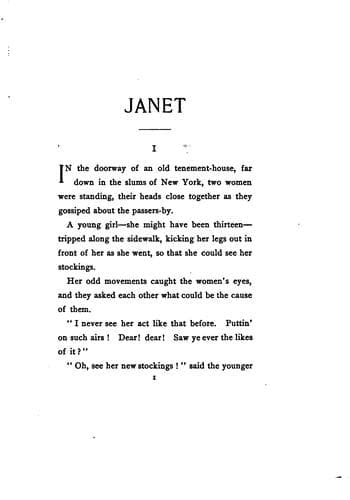
Janet; or, The Christmas StockingsGibbons, Louise Élise
General
Janet; or, The Christmas Stockings
Gibbons, Louise Élise
New York (N.Y.) -- Fiction; Poor children -- Fiction; Slums -- Fiction
“Thank you, sir,” she said. “I am very hungry. I have had nothing to eat
since yesterday noon.”
At this the gentleman didn’t smile any more, but looked sad. “Why did
you dance, then?” he said.
Roy spoke before she had a chance to answer: “Sir, Janet was hungry and
cold, and that was the best way to get warm.” The gentleman walked away,
and she could see him rub the back of his hand across his eyes. She
asked Roy what his name was, and he said he didn’t know, but it was the
Bishop.
She bought something to eat with the money, and divided it with Roy, and
he ran off to sell his papers. The organ-grinder went on his way, and
the children stopped dancing.
So on Christmas night, Janet went early to the big church, as the Bishop
had told her to do. When she got inside the door, she stood still with
wonder, for there was a great tree, as big as an out-door tree, all
lighted with little candles from the floor to the top, and all over it
were hanging sparkling toys. And when she came near to it, she saw the
Bishop standing by it.
She did not think he would know her again, but he smiled and said,
“Janet, I was expecting you.” And then he took a stick with a hook on
the end of it, and, reaching over the heads of some fine ladies who were
arranging things at the foot of the tree, he took the stockings down and
put them in her hands. Then he put his white hands on her head, and
said, “God bless you, my child! Remember, keep yourself pure and clean
to your life’s end.” Each stocking had a silver dollar in the toe, and
was filled with candy, and tied around the top with a blue ribbon to
keep the candy in.
“See!” said Janet, as she told the story, “I tie the ribbon on each leg
to keep me from getting out.” She lifted the ragged gown to show the
ribbon garters. She said she skipped out of the great big church,
hugging the stockings close to her and covering them with a bit of her
shawl to hide her treasure from the people she passed.
“Don’t you know such a fine bishop’s name?” asked one of the women.
“No,” said the child, “but Roy said he was the good Bishop who stays
down here with us, and don’t go away frolicking. And now I must go to
see Roy. There he is calling his extras at the corner.”
“Well, I never!” said one of the women, as the child skipped away. “She
seems to make friends, don’t she? She and that boy are awful fond of
each other; and now there ’s this Bishop!”
“Well,” said the other, “Janet is a pretty girl, with her dark eyes, and
her hair always braided in one long plait down her back—and even if she
is in rags, her hair is always tidy.”
“Her father sells everything that people give her—it ’s a wonder he
don’t cut off her hair and sell that. Well, the girl has a white skin,
and a pretty mouth, and a straight nose just like her mother’s. She
don’t look and she don’t act like as if she was born and raised here
among us poor folks.”
Public-domain text, read in full here on John Shaqi.
Reviews
Reviews
No reviews yet
Be the first to share your thoughts on this work.
Join the Discussion
Join the discussion
Sign in to leave a comment or review.
Sign InorCreate an account