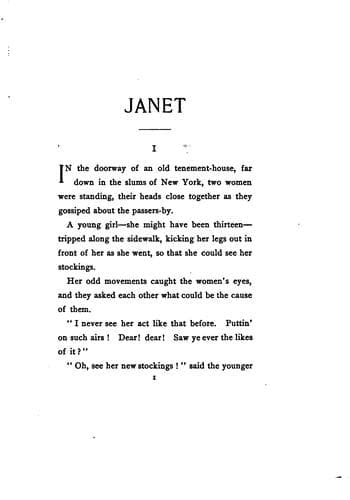
Janet; or, The Christmas StockingsGibbons, Louise Élise
General
Janet; or, The Christmas Stockings
Gibbons, Louise Élise
New York (N.Y.) -- Fiction; Poor children -- Fiction; Slums -- Fiction
She felt a warm breath on the hand that still held Roy’s, and, looking
down, she saw the mongrel dog, who had broken away from the apple-stand
and followed her. He licked her hand, and her tears fell on his head. As
she put her arms round him, she felt that he was now her only friend.
The men who carried poor Roy away pushed her roughly aside, and in a
bewildered way she followed the dog, who seemed trying to lead her to
the apple-woman. When Aunt Betsy saw the dog, she gave Janet an apple
for bringing him back. But Janet could not eat it, though she had had
nothing all day.
She tried to tell the woman about Roy, but the words would not come.
Death, to Janet, meant only the agony of separation. An hour ago, she
had Roy with her—and now he was not with her. This was all there was in
it to the poor child—nothing beyond, no hope of meeting again. Is it to
be wondered at? Uneducated, she knew nothing but her toiling daily life.
She had never been in a church but that one Christmas night, and so had
learned nothing through that channel of a life beyond. When Roy’s dying
lips murmured “Good-by, Janet!” it was forever. No home, no books, no
intelligence in her life, she was but little above the plane of her only
friend, the dog.
To others, death is but the change from darkness to light. But to Janet
and to the dog it meant the end. She was only so much above the dumb
brute that she could look into life a little farther, and so could
suffer more.
A newsboy came along and told the apple-woman the tale Janet was unable
to tell. She was shocked for the moment, for she had in her rough way
liked Roy. But the hard, business part of her nature was uppermost in a
little while. Here she was with this child on her hands. When Janet
could sell nothing, as was often the case, Roy generally had a few cents
to give her, so she had always felt that she was sure of some little pay
for the poor shelter she gave the child. But now the case was different,
and so she told Janet in no gentle way:
“You must get away from here.”
“Where?” asked Janet in a bewildered tone.
“Oh, I don’t know. Go to some of the s’cieties, or to that Bishop as
gave you them old ragged stockings you think so much of.”
“I can’t,” said the girl, despairingly. “I don’t know where to find
him.”
“Well,” said the woman, “you can stay here to-night, and I’ll give you a
bit to eat in the morning before you go.”
Janet cried all night for her companion, for she knew that in the
morning she would not hear his voice calling the papers. Roy was gone
from her—had he not said “Good-by” to her? The dog slept beside her on
the floor, and tried in every way he knew to comfort her, as he felt her
tears fall upon his head. While the old woman slept, he stole to the box
and brought Janet an apple in his mouth. Somehow his kindness comforted
her; she dried her tears and kissed his shaggy head. For his sake she
ate the apple and tried, but in vain, to sleep.
Public-domain text, read in full here on John Shaqi.
Reviews
Reviews
No reviews yet
Be the first to share your thoughts on this work.
Join the Discussion
Join the discussion
Sign in to leave a comment or review.
Sign InorCreate an account