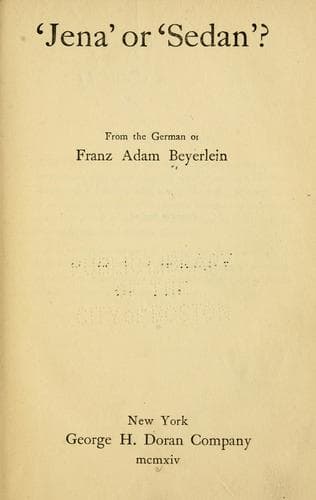
German fiction -- Translations into English; Germany. Heer -- Fiction
The colonel wrote as follows:
"MY DEAR REIMERS,--I return from Kühren about eleven o'clock, and I beg
of you to look me up this evening without fail.
"Yours,
"v. F."
Here was a glimmer of hope! Perhaps this wretched duel might yet be
avoided! The colonel of a regiment had in certain cases the right to
suspend the judgment of the court of honour, and to refer the matter
directly to the throne for a decision.
Frankly, Reimers could not think on what, in this case, such
interference could be based. The affair seemed just as clear and
distinct as could well be; a verbal quarrel whence resulted the actual
insult, which, though not serious, left not the smallest loophole for a
revocation. The duel seemed utterly inevitable.
Falkenhein was already waiting for him. The firm, clear-headed man was
in a state of almost feverish excitement. He walked restlessly up and
down the room, constantly buttoning and unbuttoning a button of his
coat.
"Thank you for coming, my dear Reimers," he said in a voice of forced
steadiness, and speaking in jerky sentences. "Tell me, you are his
second to-morrow, are you not?"
"Yes, sir," answered Reimers.
"It is a good thing that you will be there. Yes, it is a good thing.
I--I felt I must speak to you about it. It is true that a commander
should come to his decisions alone, and I have done that--but now I
must speak to some-one. I have not been to Kühren; I sent the carriage
away, and have been walking in the forest for a long time, and alone.
This duel--it is a mistake, a terrible mistake; that's certain. But my
hands are tied. I can do nothing to prevent it. And yet if things go
badly, I shall be partially responsible. My best officer, one of the
best, most excellent of men, against a lazy ne'er-do-weel! God knows
that laws are sometimes utterly unreasonable, and many of our ideas are
equally senseless. I have racked my brains to find a way out of this
difficulty, and it seems impossible. I know that Landsberg's real
reason is military antagonism; but despite that, I dare not interfere."
The colonel stopped suddenly right in front of the lieu-tenant, and
looking him squarely in the eyes, asked: "Do you really think that
Güntz's honour is affected?"
Reimers was silent. A "yes" seemed to him quite contrary to reason, and
yet he could not say "no."
Falkenhein had again begun to walk up and down the room, not awaiting a
reply.
At last he turned again to Reimers.
"Well, the matter must take its course," he said, in a somewhat calmer
tone. "One thing, however, I ask you to do for me. Directly all is over
to-morrow, will you come and tell me--quite privately? I shall hear
officially from Kauerhof. He's to be umpire, isn't he? And be quick,
won't you, even if all has gone well?--a 'three-cross' ride!"[A]
Public-domain text, read in full here on John Shaqi.
Reviews
Reviews
No reviews yet
Be the first to share your thoughts on this work.
Elsewhere in the archive
Join the Discussion
Join the discussion
Sign in to leave a comment or review.
Sign InorCreate an account