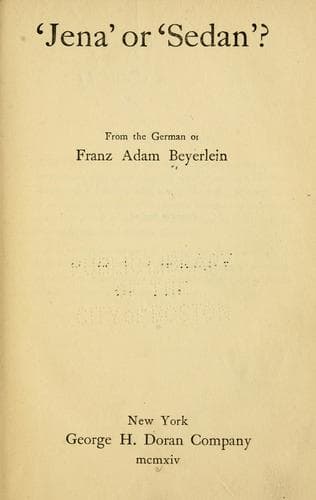
German fiction -- Translations into English; Germany. Heer -- Fiction
Well, in any case he had done right not to break away suddenly from the
time of probation on which he himself had determined; for it was
certainly strange how a calm, stead-fast man, such as he believed
himself to be, could be so swayed backwards and forwards in opposite
directions in such a short time. During the night he had been firmly
resolved to retire; a few hours later this step seemed an impossibility
to him.
Was there really so little, then, in his imagined calmness and
steadfastness?
But he was glad that the time of probation, though not shortened,
would, on the other hand, not have to be extended. He would command the
battery for a year; by then he must have made his decision.
And for to-day he was determined to put no check on his joy and good
humour.
Frau Kläre wondered at her husband, who would not leave her a moment in
peace with his teasing and nonsense, and even waked the baby up from a
sound sleep.
And Güntz stood beaming before the mother and child, laughing heartily
at the angry howl set up by his little son, and lighted his cigar with
a spill until the whole piece of paper was reduced to a cinder.
He had made that spill out of the farewell note he had placed under the
fungus-like letterweight.
CHAPTER X
"Morning red, morning red,
Light me to my dying bed!"
(_Hauff._)
Room IX. was still to remain "aristocratic"--as Weise satirically
remarked--even after Baron Walther von Frielinghausen had moved over to
the non-commissioned officers' quarters. A few days before the regiment
left for the man[oe]uvres, Count Egon Plettau arrived and took
possession of Frielinghausen's locker.
All kinds of wild reports had been circulating in the battery about
Plettau. Judging from these he appeared to be a perfect terror. A
lieutenant who had had his ears boxed, and a sergeant who had been
flung against a wall, played the chief part in these reports. But, as
a matter of fact, of the whole battery only Heppner and the senior
non-commissioned officers knew the mad count personally, and during the
five years' detention in a fortress that Plettau had had to undergo,
two sets of recruits had already come and gone without having made his
acquaintance.
The inmates of Room IX. expected to see a pale man, bent and bowed with
long imprisonment; but the new comrade bore a tolerably healthy
appearance, and had a good-tempered, friendly face.
The count was handled very tenderly by the non-commissioned officers.
They had received an intimation that as far as their duty permitted
they were to do all they could to enable this child of misfortune at
last to complete his military service.
Public-domain text, read in full here on John Shaqi.
Reviews
Reviews
No reviews yet
Be the first to share your thoughts on this work.
Elsewhere in the archive
Join the Discussion
Join the discussion
Sign in to leave a comment or review.
Sign InorCreate an account