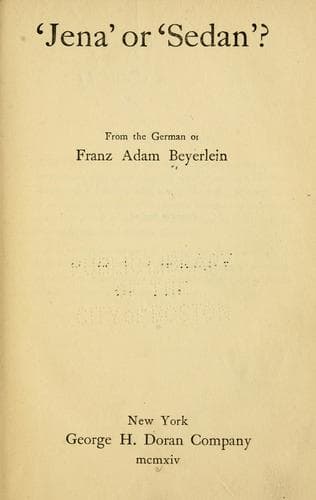
German fiction -- Translations into English; Germany. Heer -- Fiction
Such behaviour made the corporal look serious. When in the guard-room
he handed over the clothes to the non-commissioned officer who had
brought in the prisoners, he pointed with his thumb back over his
shoulder, and said: "That fellow there's not quite right in his head."
"Do you think not?" asked the other.
"Yes, I do. So I took away his braces, and now at least he can't hang
himself."
Wolf had involuntarily stood at attention as the corporal left the
cell, and when the door closed he put forward his right foot and
relaxed his position just as if the order "Stand at ease" had been
given.
He looked down at his worn uniform, the green cloth of which was grey
and threadbare, while the madder-red facings had faded to a dirty pink.
The well-polished buttons shone, and a darker patch in a corner of the
tunic showed up clearly against the shabby material.
By that patch he recognised the coat which he had worn for two endless
years, and which he still wore; and all at once he understood his fate.
Under the horror of the revelation he broke down. He sank helplessly on
the stool, and hid his face in his hands.
He was still incapable of ordered thought. Only one thing could he
grasp, that his dream of freedom lay shattered and destroyed before
him. This single, fearful, desperate certainty so entirely filled his
mind, that his capacity for other thought seemed paralysed. His senses
received external impressions, but did not transmit them to the brain.
Wolf's cell was situated in the outermost corner of the guard-house. At
a distance of about ten paces the high-road ran past the brick wall,
which was none too thick. Besides this, a small pane of the window was
open; so that the crunching of the wheels as they turned on the
freshly-laid metalling, the encouragements of the drivers to their
horses, and the cracking of the whips, could be distinctly heard. Even
the steps of the passers-by were audible, and a word here and there of
their conversation.
Wolf still sat upon the stool. All these noises reached his ear, but he
paid no heed to them.
Suddenly he raised his head.
An indistinct sound of distant singing came in snatches through the
little window, borne by gusts of wind. Nearer and nearer it approached.
Now the singers seemed to be turning a corner, their measured tread
became audible, and their hearty voices rang out:
"Reservists they may rest,
Reservists may rest,
And if reservists rest may have,
Then may reservists rest."
The song of the reservists who were leaving the barracks and marching
to the station.
From time to time the rough joke of some passing wit interrupted the
song. Then the reservists would break out into a loud laugh and call
back some still more spicy retort. But they always took up their
jingling refrain, repeating the childish words again and again, and
jogging along clumsily, keeping time to the song.
Public-domain text, read in full here on John Shaqi.
Reviews
Reviews
No reviews yet
Be the first to share your thoughts on this work.
Elsewhere in the archive
Join the Discussion
Join the discussion
Sign in to leave a comment or review.
Sign InorCreate an account