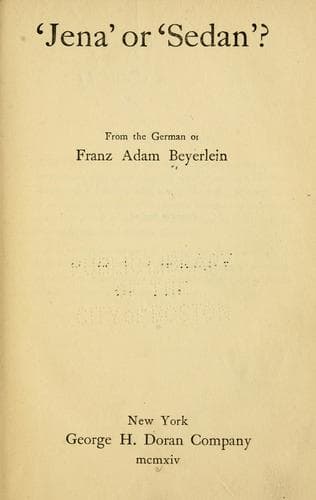
German fiction -- Translations into English; Germany. Heer -- Fiction
But when Frielinghausen stood before him, an overgrown stripling, whose
somewhat angular limbs looked still more immature in the coarse,
ready-made uniform; and when he met a pair of anxious young eyes fixed
on him, his tone softened perceptibly. There occurred to him, too, the
consciousness of another bond: Frielinghausen, like himself, belonged
to the old Thuringian nobility--possibly even to an older family than
Wegstetten's. Although this youngster had undoubtedly caused his mother
grave anxiety, yet he had not stolen copper-wire, nor taken part in any
socialistic demonstration. Wegstetten at the moment did not know of
what worse he could be accused. Naturally he would see to it that this
sympathy with the fate of a common soldier should not be wasted on an
unworthy object. Directly Frielinghausen did amiss, he would be down on
him; just as with that other sprig of nobility, Count Egon Plettau, who
had actually managed to serve nearly eight years and of that time to
spend, first six months, then two and then five years confined in a
fortress--always on account of insubordination. Now this incarnate
disgrace to the German nobility was nearing his release, and was
expected to be back again soon in the battery. Accident would determine
whether he would finish his remaining two months before he was put on
the Reserve, or would again get himself into prison.
Wegstetten had sufficient knowledge of men to recognise the difference
between the two. Count Plettau was a mere hopeless idler and vagabond.
Frielinghausen was at least inspired with a wish to pull himself
together and become good for something.
Accordingly Wegstetten spoke to him like a father; told him in a few
pointed words that he must try to be independent and steady, and must
not expect to be treated exceptionally; enjoining him by zeal and good
conduct to earn promotion as quickly as possible. But at the door he
added softly, for he did not wish the non-commissioned officers to
hear: "Be worthy of the name you bear! That alone should be sufficient
inducement to make you try to get on."
Frielinghausen stood breathless for a moment after he had closed the
door of the orderly-room. His heart was full of gratitude for the warm,
humane words, which, after all the dry exhortations and admonitions,
put new life into his heart. He earnestly resolved to repay his chief
by his deeds, and to take all possible pains to please him.
Public-domain text, read in full here on John Shaqi.
Reviews
Reviews
No reviews yet
Be the first to share your thoughts on this work.
Join the Discussion
Join the discussion
Sign in to leave a comment or review.
Sign InorCreate an account