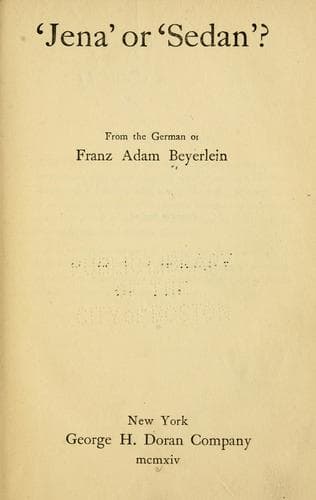
German fiction -- Translations into English; Germany. Heer -- Fiction
Little Wegstetten smiled a contented smile under his big red moustache.
Before a commanding officer like this he felt he had no cause to
tremble.
"Captain Madelung, head of the fourth battery," proceeded Kauerhof.
Mohbrinck greeted him with something like effusion: "Ah!" he cried,
"our celebrated warrior from China. I am delighted--delighted--to have
the honour of meeting you." He put on a rallying expression: "But you
must not go to the Far East now, my dear sir. I hear you have just made
happy domestic arrangements that will keep you at home."
Madelung bowed; just before the man[oe]uvres he had married the eldest
maid-of-honour.
The youngest captain of the regiment, Güntz, was now presented. Major
Mohbrinck assumed his would-be-agreeable smile, and said jokingly:
"Dear, dear! our youngest captain, and so stout already!"
Güntz looked at him. Well, of course he was not exactly one of the slim
ones, but why should this rather uncomplimentary remark be fired in his
face?
Major Schrader saved him the trouble of answering. He patted him
good-humouredly on the back, and said: "Well, yes, he has got something
of a corporation, like Dr. Luther; but that does not prevent him from
shining brilliantly in the constellation of my commanders of
batteries."
Mohbrinck turned to him, and remarked sweetly; "Oh, I should never have
suggested such a thing, my dear sir. I am quite well aware of the
merits of Captain Güntz." And he touched Güntz's little red eagle; his
own breast was still undecorated.
It was the common talk of the army that the 80th Regiment, Eastern
Division, Field Artillery, had, under Falkenhein's command, become a
perfect pattern to all the troops. It would therefore have seemed most
expedient to carry on the methods of its former chief. But Mohbrinck
considered that to do so would make him appear an officer without
military distinction or views of his own. He posed as having studied to
a nicety every little whim and peculiarity of the major-general
commanding the brigade, and had made up his mind that at the review his
regiment should have no fault found with it, not even if for months
everything more important should be set aside in order to drill into
the men every little fancy of the brigadier.
"I tell you, sir, I have heard the last word of the major-general on
this subject or that," was his ever-recurring refrain.
Public-domain text, read in full here on John Shaqi.
Reviews
Reviews
No reviews yet
Be the first to share your thoughts on this work.
Elsewhere in the archive
Join the Discussion
Join the discussion
Sign in to leave a comment or review.
Sign InorCreate an account