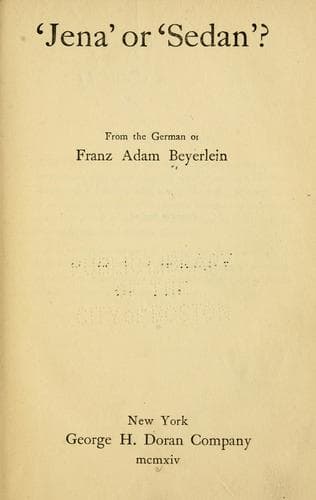
German fiction -- Translations into English; Germany. Heer -- Fiction
"You are well out of that, thank God! Reimers," he said, once more
shaking the lieutenant's hand; "and it looks as if the improvement
would be permanent, considering the test to which your health has been
put."
"It was rather _va banque_, sir," replied the lieutenant. "Either all
or nothing."
"I decidedly prefer the all," said Falkenhein, in such a hearty,
affectionate tone that a rush of devotion carried the lieutenant past
the barriers of formality. He bent quickly over the colonel's hand and
kissed it. Tears stood in his eyes--tears of grateful pleasure. Now he
indeed felt himself back in his native country.
How he had longed for it, day after day, during this year of furlough!
At first when, in Cairo, he was again laid low by the fatigues of the
journey, he had thought of his country with pensive melancholy. Later,
as his strength returned, homesickness asserted itself increasingly; he
suffered from it more than from his gradually-subsiding bodily malady,
and the aimless life of a health-resort only increased his sufferings.
He could never have resigned himself to pass long months of such
inaction in a strange land; and when he joined the Boer forces, it was
to no small extent in order to counteract the torturing longing for
Germany.
He loved his country with a passionate ardour. The ideas of greatness,
power and sovereignty were inseparably connected in his mind with the
name of the German Empire. But his chief enthusiasm was reserved for
the diligent, unostentatious work, quietly accomplished and conscious
of its aim, which, begun by Stein, Scharnhorst and Boyen, had led
through long struggles to such a glorious result. He reviewed the whole
story with the eye of a soldier from the collapse at Jena onward to the
last great war he seemed to trace an uninterruptedly ascending line,
not diverted even by Prussia's temporary political defeats. In the
unparalleled siege of Sedan a height of military efficiency had been
reached from which no further ascent was possible. He could not imagine
anything in the whole world more honourable than to belong to that
splendid army of Sedan; and he wore his officer's sword-knot with a
pride far removed from any kind of conceit: in fact, nearly akin to
religious veneration.
As a boy, it had been his bitterest grief that his mother's wishes and
the doctor's opinion were against his becoming a soldier,--an officer
like his dead father, who had fought in the great campaign. His mother
and the doctor had feared that he was too weakly for the military
profession. In order to remove this objection, the boy voluntarily
subjected himself to heroic discipline, and by strictly following a
graduated system of physical exercises inured his body to hardships,
until he was actually found fit for service. Conquered by such
persistent devotion, his mother at last yielded to his wishes; but she
saw him wear his father's familiar old uniform only a few times, for
she died shortly after, barely forty years old.
Public-domain text, read in full here on John Shaqi.
Reviews
Reviews
No reviews yet
Be the first to share your thoughts on this work.
Join the Discussion
Join the discussion
Sign in to leave a comment or review.
Sign InorCreate an account