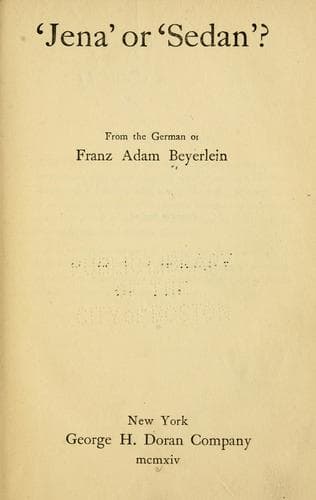
German fiction -- Translations into English; Germany. Heer -- Fiction
But chance threw in his way a gift which to some extent compensated him
for the loss of his friend. He and Colonel von Falkenhein were brought
together; and, by the irony of fate, at one of these same odious balls.
After working through his duty dances, Reimers had allowed himself to
omit a polka, and was leaning out of a window in the end room of the
suite, when Colonel Falkenhein tapped him on the shoulder.
The colonel was bored; for those of the older men who were not occupied
with the ladies had set themselves down to cards, and he--a widower,
whose only daughter was still at school--could not bear cards, and
liked dancing still less. This Lieutenant Reimers, standing alone
gazing out into the night, seemed a kindred spirit.
The young officer had already excited his interest; his behaviour as a
soldier was loudly praised by his superiors; and then unprofessionally
he was distinguished from the average type of young lieutenant by a
certain attractive maturity of bearing, without, however, impressing
one as a prig. Priggishness was even less endurable to Falkenhein than
play and dancing.
The colonel had the gift of making people open their hearts to him by
means of a few judicious questions, and could very well distinguish
between genuine and spurious sentiment.
Reimers answered with a candour which astonished himself most of all,
and Falkenhein listened with a pleased attention. Here was a man after
his own heart, possessed by a manly seriousness, and with a deliberate
lofty aim in life; not merely dreaming of substituting a general's
epaulettes for the simple shoulder-knots of a lieutenant. Here, too,
was a fine enthusiasm, which touched the veteran of fifty and warmed
his heart. It recalled the old warlike days and the cry: "Only put us
to the proof! and rather to-day than to-morrow!" Ah! since those days
he had learnt to judge such things rather differently; but nevertheless
it was the right way for youth to regard them. Such enthusiasm was a
little exaggerated, at any rate as things stood at present, and also a
trifle shortsighted. It was now no longer as in the days of 1870 and
after, when the watch on the Rhine had to be kept for fear of
vengeance. He could not join as heartily as he might then have done in
the proud joy of the young officer.
He felt inclined to take himself to task for this, and on no account
would he pour cold water on this fine flame of enthusiasm. It was the
very thing in which the present time was most lacking: patriotism as a
genuine conviction rooted firmly and deep in the breast, not venting
itself in mere cheering and hurrahs; and accompanied by a steady
comprehension of the soldier's profession as simply a constant
readiness for war.
Public-domain text, read in full here on John Shaqi.
Reviews
Reviews
No reviews yet
Be the first to share your thoughts on this work.
Join the Discussion
Join the discussion
Sign in to leave a comment or review.
Sign InorCreate an account