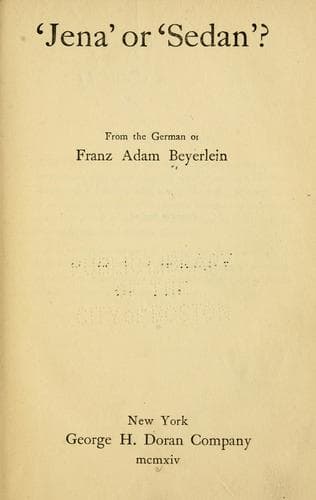
German fiction -- Translations into English; Germany. Heer -- Fiction
The father was probably heavier of heart than the son, as they paced
through the night together; but when they stood once more before their
door, after making a somewhat lengthy round, he only said: "Well, well,
young 'un; you'll often think of this. Now sleep well, your last night
at home." And as his son went off upstairs he added softly to himself,
"My dear good boy!"
Early next day Franz Vogt departed.
The greater number of the recruits left the train when it reached
the capital, and it was only a small company that proceeded onwards to
the little garrison town.
Two or three non-commissioned officers received the detachment when
it ultimately arrived at its destination. The recruits were then formed
into squads and conducted to a large exercise-ground. The main body,
hailing from the coal-mines and factories of the neighbouring mountain
district, had already arrived by special train. There must have been
about four hundred men altogether. Two or three officers, and numerous
non-commissioned officers with helmets and shoulder-straps, were
standing about. An endless calling over of names began. Those who were
told off to the first battery were taken first, and were led away as
soon as their number was complete. Then came those of the second
battery, then the third, and so on. The other recruits stood looking
dully in front of them, while those whose names were called out pressed
forward through the ranks with feverish haste, jostling every one else
with their boxes and bundles.
Franz Vogt listened at first full of expectation. Each time he
thought that his name would be the next; but when the third battery had
marched off without him his interest began to flag, and he thought he
would take a look round. What he saw was not very encouraging. The
large square exercise-ground was strewn with a fine black dust,
coke-refuse, evidently; on three sides it was surrounded by a wooden
paling through which bare fields could be seen, and, in the direction
of the town, miserable-looking vegetable-gardens in all the desolation
of autumn. On the fourth side was an irregular row of buildings; first
a long shed with windows at wide intervals, before which stood a
sentry, who gazed across at the recruits with great curiosity; next a
forge, from the door of which a grimy blacksmith and his assistants
were watching, and a soldier in a grey jacket was leading out a black
mare that had just been shod; then came another shed with large gates,
one of which was open, and a number of men inside were busily engaged
around a gun with cloths and brushes.
Public-domain text, read in full here on John Shaqi.
Reviews
Reviews
No reviews yet
Be the first to share your thoughts on this work.
Join the Discussion
Join the discussion
Sign in to leave a comment or review.
Sign InorCreate an account