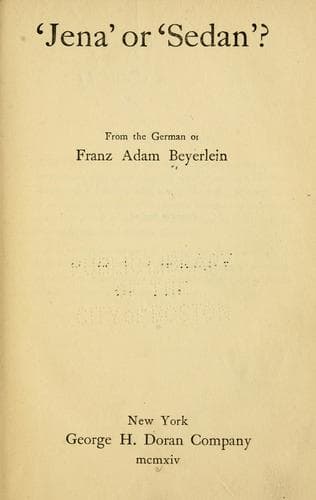
German fiction -- Translations into English; Germany. Heer -- Fiction
The escort of armed and spurred non-commissioned officers had
already made Vogt feel as if he were going to prison, and the entry
into the barracks made it full clear that he was, at any rate, under
stringent discipline, and must henceforth renounce a large measure of
individual freedom. The opening gates were of iron, and were adorned
with sharp spikes on the top, so as to make climbing over impossible; a
sentry, too, stood at the entrance. The gates opened on to a spacious
courtyard surrounded by buildings. Not a green thing was to be seen,
and the gravelled yard was as naked and barren as the buildings
themselves, whose blank windows suggested deserted rooms. Only a few
were graced with white curtains, which gave promise of habitation. Even
the young chestnut-trees that had been planted round the borders of the
courtyard throve but poorly; now and then a yellow leaf fell to the
ground, although the woods outside were still a mass of green.
The quarters of the sixth battery were exactly facing the entrance,
but the inner yard was evidently held sacred, for the recruits were
taken round it by a paved pathway.
The little corporal now marshalled them carefully in two rows, and
announced to an older man in a green jacket trimmed with red braid who
was standing in a doorway: "The recruits are here, sir."
"Are they all there?" asked the other, as he came down the steps.
"All here, sir," replied the little man.
The sergeant-major passed slowly along the ranks, and examined each
recruit with a searching glance. Vogt looked him fearlessly in the
face. He reminded him of his father. He, too, could look one through
and through like that; but one need never cast down one's eyes if one
has a clear conscience.
The recruits were next conducted into the barrack-rooms, where to each
was allotted a locker of his own, in which a white napkin and a spoon
had already been placed. After putting their bundles into these
lockers, they were taken straight to the dining-hall. Each gave in his
white napkin through a serving-hatch and received it back again full,
almost burning his fingers with the contents before he could put it
down on the well-scoured wooden table. Beans and bacon was the fare,
and it tasted rather good. No wonder, when the men had been travelling
ever since early morning.
Vogt's neighbour during the march came and sat next him on the wooden
bench. He wiped his short black beard, and nodded to Vogt.
"This goes down pretty quick, doesn't it?" he said, as he spooned up
his food.
"Rather!" answered Vogt. And the other went on, as he pointed to his
empty napkin:
"If only our two years would go as fast!"
They soon made acquaintance. Weise was the man's name, and he was a
locksmith from a factory in the neighbouring coal-district. But they
only had time to exchange the barest preliminaries of intercourse when
they had to get up again, go and wash their dishes and spoons at a tap,
and then return.
Public-domain text, read in full here on John Shaqi.
Reviews
Reviews
No reviews yet
Be the first to share your thoughts on this work.
Join the Discussion
Join the discussion
Sign in to leave a comment or review.
Sign InorCreate an account