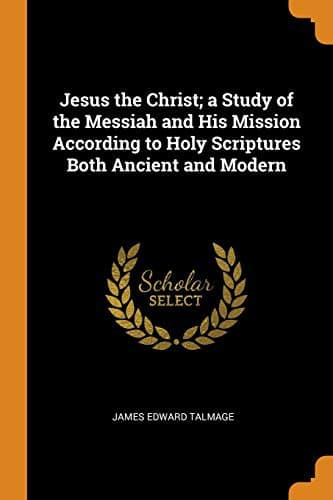
Jesus the Christ: A Study of the Messiah and His Mission According to Holy; Scriptures Both Ancient and ModernTalmage, James E. (James Edward)
Religion
Jesus the Christ: A Study of the Messiah and His Mission According to Holy; Scriptures Both Ancient and Modern
Talmage, James E. (James Edward)
Christian biography -- Palestine; Jesus Christ -- Biography; Jesus Christ -- Mormon interpretations
Touching the matter of the defilement to which the temple courts had
been subjected by traffickers acting under priestly license, Farrar,
(_Life of Christ_, p. 152), gives us the following: "And this was the
entrance-court to the Temple of the Most High! The court which was a
witness that that house should be a House of Prayer for all nations had
been degraded into a place which, for foulness, was more like shambles,
and for bustling commerce more like a densely-crowded bazaar; while the
lowing of oxen, the bleating of sheep, the Babel of many languages, the
huckstering and wrangling, and the clinking of money and of balances
(perhaps not always just), might be heard in the adjoining courts,
disturbing the chant of the Levites and the prayers of priests!"
5. The Servility of the Jews in the Presence of Jesus.--The record of
the achievement of Jesus, in ridding the temple courts of those who had
made the House of the Lord a market place, contains nothing to suggest
the inference that He exercized superhuman strength or more than manly
vigor. He employed a whip of His own making, and drove all before Him.
They fled helter-skelter. None are said to have voiced an objection
until the expulsion had been made complete. Why did not some among the
multitude object? The submission appears to have been abject and servile
in the extreme. Farrar, (_Life of Christ_, pp. 151, 152) raises the
question and answers it with excellent reasoning and in eloquent lines:
"Why did not this multitude of ignorant pilgrims resist? Why did these
greedy chafferers content themselves with dark scowls and muttered
maledictions, while they suffered their oxen and sheep to be chased into
the streets and themselves ejected, and their money flung rolling on the
floor, by one who was then young and unknown, and in the garb of
despised Galilee? Why, in the same way we might ask, did Saul suffer
Samuel to beard him in the very presence of his army? Why did David
abjectly obey the orders of Joab? Why did Ahab not dare to arrest Elijah
at the door of Naboth's vineyard? Because sin is weakness; because there
is in the world nothing so abject as a guilty conscience, nothing so
invincible as the sweeping tide of a Godlike indignation against all
that is base and wrong. How could these paltry sacrilegious buyers and
sellers, conscious of wrongdoing, oppose that scathing rebuke, or face
the lightnings of those eyes that were enkindled by an outraged
holiness? When Phinehas the priest was zealous for the Lord of Hosts,
and drove through the bodies of the prince of Simeon and the Midianitish
woman with one glorious thrust of his indignant spear, why did not
guilty Israel avenge that splendid murder? Why did not every man of the
tribe of Simeon become a Goel to the dauntless assassin? Because Vice
cannot stand for one moment before Virtue's uplifted arm. Base and
grovelling as they were, these money-mongering Jews felt, in all that
Public-domain text, read in full here on John Shaqi.
Reviews
Reviews
No reviews yet
Be the first to share your thoughts on this work.
Elsewhere in the archive
Join the Discussion
Join the discussion
Sign in to leave a comment or review.
Sign InorCreate an account