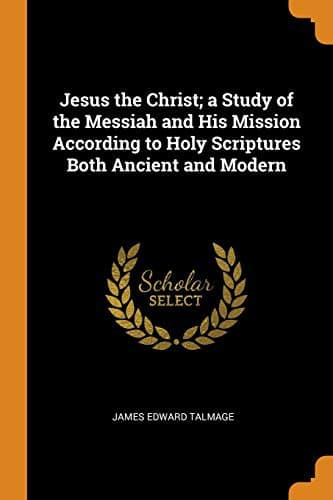
Jesus the Christ: A Study of the Messiah and His Mission According to Holy; Scriptures Both Ancient and ModernTalmage, James E. (James Edward)
Religion
Jesus the Christ: A Study of the Messiah and His Mission According to Holy; Scriptures Both Ancient and Modern
Talmage, James E. (James Edward)
Christian biography -- Palestine; Jesus Christ -- Biography; Jesus Christ -- Mormon interpretations
remnant of their souls which was not yet eaten away by infidelity and
avarice, that the Son of Man was right.
"Nay, even the Priests and Pharisees, and Scribes and Levites, devoured
as they were by pride and formalism, could not condemn an act which
might have been performed by a Nehemiah or a Judas Maccabaeus, and which
agreed with all that was purest and best in their traditions. But when
they had heard of this deed, or witnessed it, and had time to recover
from the breathless mixture of admiration, disgust, and astonishment
which it inspired, they came to Jesus, and though they did not dare to
condemn what He had done, yet half indignantly asked Him for some sign
that He had a right to act thus."
6. Jewish Regard for the Temple.--The Jews professed high regard for the
temple. "An utterance of the Savior, construed by the dark-minded as an
aspersion upon the temple, was used against Him as one of the chief
accusations on which His death was demanded. When the Jews clamored for
a sign of His authority He predicted His own death and subsequent
resurrection, saying, 'Destroy this temple, and in three days I will
raise it up,' (John 2:19-22; see also Matt. 26:61; 27:40; Mark 14:58;
15:29). They blindly regarded this remark as a disrespectful allusion to
their temple, a structure built by human hands, and they refused to
forget or forgive. That this veneration continued after the crucifixion
of our Lord is evident from accusations brought against Stephen, and
still later against Paul. In their murderous rage the people accused
Stephen of disrespect for the temple, and brought false witnesses who
uttered perjured testimony saying, 'This man ceaseth not to speak
blasphemous words against this holy place.' (Acts 6:13.) And Stephen was
numbered with the martyrs. When it was claimed that Paul had brought
with him into the temple precincts, a Gentile, the whole city was
aroused, and the infuriated mob dragged Paul from the place and sought
to kill him. (Acts 21:26-31.)"--The author; _House of the Lord_, pp. 60,
61.
7. Some of the "Chief Rulers" Believed.--Nicodemus was not the only one
among the ruling classes who believed in Jesus; but of most of these we
learn nothing to indicate that they had sufficient courage to come even
by night to make independent and personal inquiry. They feared the
result in loss of popularity and standing. We read in John 12:42, 43:
"Nevertheless among the chief rulers also many believed on him; but
because of the Pharisees they did not confess him, lest they should be
put out of the synagogue: for they loved the praise of men more than the
praise of God." Note also the instance of the scribe who proffered to
become a professed disciple, but, probably because of some degree of
insincerity or unfitness, was rather discouraged than approved by Jesus.
(Matt. 8:19, 20.)
Public-domain text, read in full here on John Shaqi.
Reviews
Reviews
No reviews yet
Be the first to share your thoughts on this work.
Elsewhere in the archive
Join the Discussion
Join the discussion
Sign in to leave a comment or review.
Sign InorCreate an account