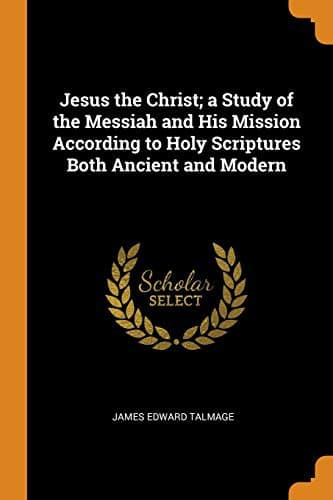
Jesus the Christ: A Study of the Messiah and His Mission According to Holy; Scriptures Both Ancient and ModernTalmage, James E. (James Edward)
Religion
Jesus the Christ: A Study of the Messiah and His Mission According to Holy; Scriptures Both Ancient and Modern
Talmage, James E. (James Edward)
Christian biography -- Palestine; Jesus Christ -- Biography; Jesus Christ -- Mormon interpretations
The law forbade the awful sin of adultery; Christ said that the sin
began in the lustful glance, the sensual thought; and He added that it
was better to become blind than to look with evil eye; better to lose a
hand than to work iniquity therewith. Touching the matter of
divorcement, in which great laxity prevailed in that day, Jesus declared
that except for the most serious offense of infidelity to marriage vows,
no man could divorce his wife without becoming himself an offender, in
that she, marrying again while still a wife not righteously divorced,
would be guilty of sin, and so would be the man to whom she was so
married.
Of old it had been forbidden to swear or take oaths except in solemn
covenant before the Lord; but in the gospel dispensation the Lord
forbade that men swear at all; and the heinousness of wanton oaths was
expounded. Grievously sinful indeed it was and is to swear by heaven,
which is the abode of God; or by earth, which is His creation and by Him
called His footstool; or by Jerusalem, which was regarded by those who
swore as the city of the great King; or by one's own head, which is part
of the body God has created. Moderation in speech, decision and
simplicity were enjoined, to the exclusion of expletives, profanity and
oaths.
Of old the principle of retaliation had been tolerated, by which one who
had suffered injury could exact or inflict a penalty of the same nature
as the offense. Thus an eye was demanded for the loss of an eye, a tooth
for a tooth, a life for a life.[528] In contrast, Christ taught that men
should rather suffer than do evil, even to the extent of submission
without resistance under certain implied conditions. His forceful
illustrations--that if one were smitten on one cheek he should turn the
other to the smiter; that if a man took another's coat by process of
law, the loser should allow his cloak to be taken also; that if one was
pressed into service to carry another's burden a mile, he should
willingly go two miles; that one should readily give or lend as
asked--are not to be construed as commanding abject subserviency to
unjust demands, nor as an abrogation of the principle of
self-protection. These instructions were directed primarily to the
apostles, who would be professedly devoted to the work of the kingdom to
the exclusion of all other interests. In their ministry it would be
better to suffer material loss or personal indignity and imposition at
the hands of wicked oppressors, than to bring about an impairment of
efficiency and a hindrance in work through resistance and contention. To
such as these the Beatitudes were particularly applicable--Blessed are
the meek, the peace-makers, and they that are persecuted for
righteousness' sake.
Public-domain text, read in full here on John Shaqi.
Reviews
Reviews
No reviews yet
Be the first to share your thoughts on this work.
Elsewhere in the archive
Join the Discussion
Join the discussion
Sign in to leave a comment or review.
Sign InorCreate an account