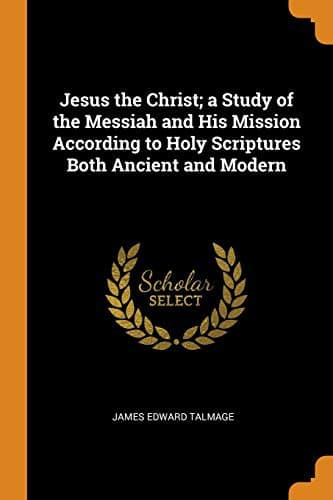
Jesus the Christ: A Study of the Messiah and His Mission According to Holy; Scriptures Both Ancient and Modern — John Shaqi
Jesus the Christ: A Study of the Messiah and His Mission According to Holy; Scriptures Both Ancient and ModernTalmage, James E. (James Edward)
Religion
Jesus the Christ: A Study of the Messiah and His Mission According to Holy; Scriptures Both Ancient and Modern
Talmage, James E. (James Edward)
Christian biography -- Palestine; Jesus Christ -- Biography; Jesus Christ -- Mormon interpretations
What other man has lived with power to withstand death, over whom death
could not prevail except through his own submission? Yet Jesus Christ
could not be slain until His "hour had come", and that, the hour in
which He voluntarily surrendered His life, and permitted His own decease
through an act of will. Born of a mortal mother He inherited the
capacity to die; begotten by an immortal Sire He possessed as a heritage
the power to withstand death indefinitely. He literally gave up His
life; to this effect is His own affirmation: "Therefore doth my Father
love me, because I lay down my life, that I might take it again. No man
taketh it from me, but I lay it down of myself. I have power to lay it
down, and I have power to take it again."[45] And further: "For as the
Father hath life in himself; so hath he given to the Son to have life in
himself."[46] Only such a One could conquer death; in none but Jesus the
Christ was realized this requisite condition of a Redeemer of the world.
What other man has come to earth with such appointment, clothed with the
authority of such foreordination? The atoning mission of Jesus Christ
was no self-assumption. True, He had offered Himself when the call was
made in the heavens; true, He had been accepted, and in due time came to
earth to carry into effect the terms of that acceptance; but He was
chosen by One greater than Himself. The burden of His confession of
authority was ever to the effect that He operated under the direction of
the Father, as witness these words: "I came down from heaven, not to do
mine own will, but the will of him that sent me."[47] "My meat is to do
the will of him that sent me, and to finish his work."[48] "I can of
mine own self do nothing: as I hear, I judge: and my judgment is just;
because I seek not mine own will but the will of the Father which hath
sent me."[49]
Through the atonement accomplished by Jesus Christ--a redeeming service,
vicariously rendered in behalf of mankind, all of whom have become
estranged from God by the effects of sin both inherited and individually
incurred--the way is opened for a reconciliation whereby man may come
again into communion with God, and be made fit to dwell anew and forever
in the presence of his Eternal Father. This basal thought is admirably
implied in our English word, "atonement," which, as its syllables
attest, is _at-one-ment_, "denoting reconciliation, or the bringing into
agreement of those who have been estranged."[50] The effect of the
atonement may be conveniently considered as twofold:
1--The universal redemption of the human race from death invoked by the
fall of our first parents; and,
2--Salvation, whereby means of relief from the results of individual sin
are provided.
Public-domain text, read in full here on John Shaqi.
Reviews
Reviews
No reviews yet
Be the first to share your thoughts on this work.
Join the Discussion
Join the discussion
Sign in to leave a comment or review.
Sign InorCreate an account