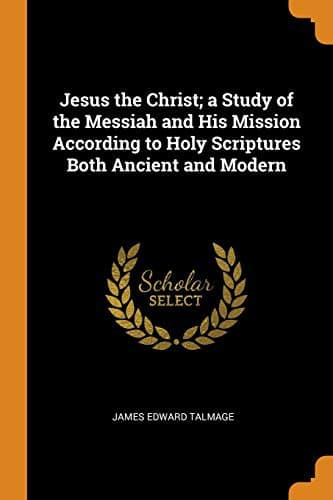
Jesus the Christ: A Study of the Messiah and His Mission According to Holy; Scriptures Both Ancient and ModernTalmage, James E. (James Edward)
Religion
Jesus the Christ: A Study of the Messiah and His Mission According to Holy; Scriptures Both Ancient and Modern
Talmage, James E. (James Edward)
Christian biography -- Palestine; Jesus Christ -- Biography; Jesus Christ -- Mormon interpretations
Some Bible expositors have professed to find in this splendid parable
evidence of decisive fatalism in the lives of individuals, so that those
whose spiritual state is comparable to the hardened pathway or wayside
ground, to the shallow soil on stony floor, or to the neglected,
thorn-ridden tract, are hopelessly and irredeemably bad; while the souls
who may be likened unto good soil are safe against deterioration and
will be inevitably productive of good fruit. Let it not be forgotten
that a parable is but a sketch, not a picture finished in detail; and
that the expressed or implied similitude in parabolic teaching cannot
logically and consistently be carried beyond the limits of the
illustrative story. In the parable we are considering, the Teacher
depicted the varied grades of spiritual receptivity existing among men,
and characterized with incisive brevity each of the specified grades. He
neither said nor intimated that the hard-baked soil of the wayside might
be plowed, harrowed, fertilized, and so be rendered productive; nor that
the stony impediment to growth might not be broken up and removed, or an
increase of good soil be made by actual addition; nor that the thorns
could never be uprooted and their former habitat be rendered fit to
support good plants. The parable is to be studied in the spirit of its
purpose; and strained inferences or extensions are unwarranted. A strong
metaphor, a striking simile, or any other expressive figure of speech,
is of service only when rationally applied; if carried beyond the bounds
of reasonable intent, the best of such may become meaningless or even
absurd.
THE WHEAT AND THE TARES.
Another parable, somewhat closely related to the foregoing as to the
actual story, dealing again with seed and sowing, and, like the first,
accompanied by an interpretation, was delivered by the Master as
follows:
"The kingdom of heaven is likened unto a man which sowed good
seed in his field: but while men slept, his enemy came and sowed
tares among the wheat, and went his way. But when the blade was
sprung up, and brought forth fruit, then appeared the tares
also. So the servants of the householder came and said unto him,
Sir, didst not thou sow good seed in thy field? from whence then
hath it tares? He said unto them, An enemy hath done this. The
servants said unto him, Wilt thou then that we go and gather
them up? But he said, Nay; lest while ye gather up the tares, ye
root up also the wheat with them. Let both grow together until
the harvest: and in the time of harvest I will say to the
reapers, Gather ye together first the tares, and bind them in
bundles to burn them: but gather the wheat into my barn."[621]
When Jesus had retired to the house in which He lodged, the disciples
came, saying: "Declare unto us the parable of the tares of the field."
Public-domain text, read in full here on John Shaqi.
Reviews
Reviews
No reviews yet
Be the first to share your thoughts on this work.
Elsewhere in the archive
Join the Discussion
Join the discussion
Sign in to leave a comment or review.
Sign InorCreate an account