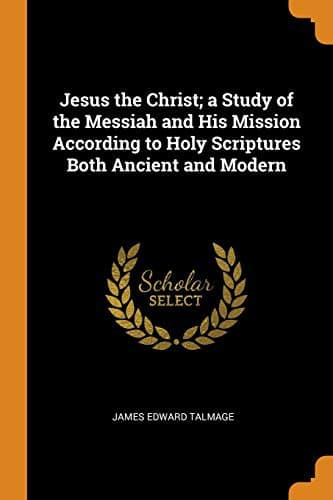
Jesus the Christ: A Study of the Messiah and His Mission According to Holy; Scriptures Both Ancient and ModernTalmage, James E. (James Edward)
Religion
Jesus the Christ: A Study of the Messiah and His Mission According to Holy; Scriptures Both Ancient and Modern
Talmage, James E. (James Edward)
Christian biography -- Palestine; Jesus Christ -- Biography; Jesus Christ -- Mormon interpretations
"But behold, in the last days, even now while the Lord is
beginning to bring forth the word, and the blade is springing up
and is yet tender. Behold, verily I say unto you, the angels are
crying unto the Lord day and night, who are ready and waiting to
be sent forth to reap down the fields; but the Lord saith unto
them, pluck not up the tares while the blade is yet tender, (for
verily your faith is weak,) lest you destroy the wheat also.
Therefore, let the wheat and the tares grow together until the
harvest is fully ripe, then ye shall first gather out the wheat
from among the tares, and after the gathering of the wheat,
behold and lo! the tares are bound in bundles, and the field
remaineth to be burned."[625]
THE SEED GROWING SECRETLY.
Matthew records the Parable of the Tares as immediately following that
of the Sower; Mark places in the same position of sequence a parable
found in his writings alone. It is presented in outline form, and by
critical expositors would be classed rather as a simple analogy than a
typical parable. Read it:
"And he said, So is the kingdom of God, as if a man should cast
seed into the ground; and should sleep, and rise night and day,
and the seed should spring and grow up, he knoweth not how. For
the earth bringeth forth fruit of herself; first the blade, then
the ear, after that the full corn in the ear. But when the fruit
is brought forth, immediately he putteth in the sickle, because
the harvest is come."[626]
We have no record of the disciples asking nor of the Master giving any
interpretation of this, or of any later parable.[627] In this story we
find effectively illustrated the fact of the vitality of the seed of
truth, though the secret processes of its growth be a mystery to all
save God alone. A man having planted seed must needs leave it alone. He
may tend the field, removing weeds, protecting the plants as best he
may, but the growth itself is dependent upon conditions and forces
beyond his power to ultimately control. Though it were Paul who planted
and Apollos who watered, none but God could insure the increase.[628]
The one who sowed may go about his other affairs, for the field does not
demand continuous or exclusive attention; nevertheless, under the
influences of sunshine and shower, of breeze and dew, the blade
develops, then the ear, and in due time the full corn in the ear. When
the grain is ripe the man gladly harvests his crop.
Public-domain text, read in full here on John Shaqi.
Reviews
Reviews
No reviews yet
Be the first to share your thoughts on this work.
Elsewhere in the archive
Join the Discussion
Join the discussion
Sign in to leave a comment or review.
Sign InorCreate an account