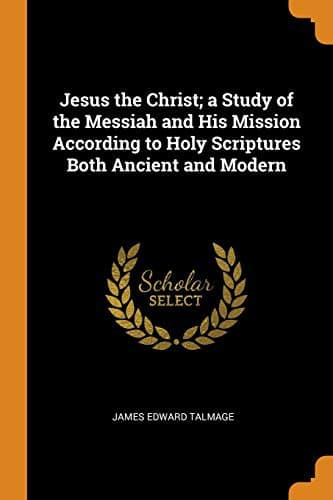
Jesus the Christ: A Study of the Messiah and His Mission According to Holy; Scriptures Both Ancient and ModernTalmage, James E. (James Edward)
Religion
Jesus the Christ: A Study of the Messiah and His Mission According to Holy; Scriptures Both Ancient and Modern
Talmage, James E. (James Edward)
Christian biography -- Palestine; Jesus Christ -- Biography; Jesus Christ -- Mormon interpretations
2. Jesus Christ, the God of Israel.--"That Jesus Christ was the same
Being who called Abraham from his native country, who led Israel out of
the land of Egypt with mighty miracles and wonders, who made known to
them His law amid the thunderings of Sinai, who delivered them from
their enemies, who chastened them for their disobedience, who inspired
their prophets, and whose glory filled Solomon's temple, is evident from
all the inspired writings, and in none more so than in the Bible.
"His lamentation over Jerusalem evidences that, in His humanity, He had
not forgotten His former exalted position: 'O Jerusalem, Jerusalem, thou
that killest the prophets, and stonest them which are sent unto thee,
how often would I have gathered thy children together ... and ye would
not!' (Matt. 23:37). It was this Creator of the world, this mighty
Ruler, this Controller of the destinies of the human family, who, in His
last moments, cried out in the agony of His soul, 'My God, my God, why
hast thou forsaken me?'" (Mark 15:34.)--From _Compendium of the
Doctrines of the Gospel_, by Franklin D. Richards and James A. Little.
3. "Jehovah" a Name Not Uttered by the Jews.--Long prior to the time of
Christ, certain schools among the Jews, ever intent on the observance of
the letter of the law, though not without disregard of its spirit, had
taught that the mere utterance of the name of God was blasphemous, and
that the sin of so doing constituted a capital offense. This extreme
conception arose from the accepted though uninspired interpretation of
Lev. 24:16, "And he that blasphemeth the name of the Lord, he shall
surely be put to death, and all the congregation shall certainly stone
him: as well the stranger, as he that is born in the land, when he
blasphemeth the name of the Lord, shall be put to death." We take the
following from Smith's _Comprehensive Dictionary of the Bible_, article
"Jehovah": "The true pronunciation of this name, [Yehovah] by which God
was known to the Hebrews, has been entirely lost, the Jews themselves
scrupulously avoiding every mention of it, and substituting in its stead
one or other of the words with whose proper vowel-points it may happen
to be written [_Adonai_, Lord, or _Elohim_, God].... According to Jewish
tradition it was pronounced but once a year by the high priest on the
day of atonement when he entered the Holy of Holies; but on this point
there is some doubt."
FOOTNOTES:
[67] See "God and the Godhead," in the author's "Articles of Faith,"
lecture ii.
[68] Gen. 1:26; and 3:22.
[69] P. of G.P., Moses 2:26; and 4:28.
[70] P. of G.P., Abraham, chaps. 4 and 5.
[71] See page 10; John 1:1; and P. of G.P., Moses 1:32.
[72] Heb. 1:1, 2; see also 1 Cor. 8:6.
[73] Colos. 1:16, 17.
[74] John 1:1-3.
[75] B. of M., Helaman 14:12; see also Mosiah 3:8; 4:2: Alma 11:39.
[76] B. of M., 3 Nephi 9:15.
[77] B. of M., 3 Nephi 15:4, 5.
[78] Doc. and Cov. 45:1.
[79] Doc. and Cov. 14:9; see also 29:1, 31; 76:24.
Public-domain text, read in full here on John Shaqi.
Reviews
Reviews
No reviews yet
Be the first to share your thoughts on this work.
Join the Discussion
Join the discussion
Sign in to leave a comment or review.
Sign InorCreate an account