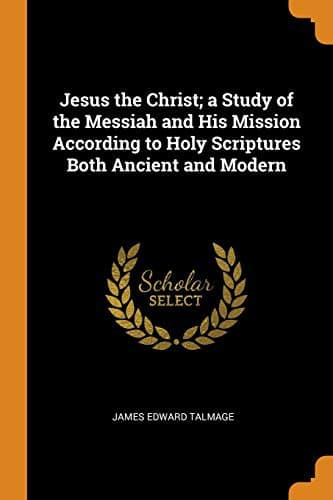
Jesus the Christ: A Study of the Messiah and His Mission According to Holy; Scriptures Both Ancient and ModernTalmage, James E. (James Edward)
Religion
Jesus the Christ: A Study of the Messiah and His Mission According to Holy; Scriptures Both Ancient and Modern
Talmage, James E. (James Edward)
Christian biography -- Palestine; Jesus Christ -- Biography; Jesus Christ -- Mormon interpretations
The national hope of a Messiah based on promise and prophecy had become
confused in the Jewish mind, through the influence of rabbinism with its
many vagaries, and its "private interpretation"[210] made to appear
authoritative by the artificially sustained prestige of the expositors;
yet certain conditions had been emphasized as essential, even by the
rabbis, and by these essentials would be judged the claim of any Jew who
might declare himself to be the long expected One. It was beyond
question that the Messiah was to be born within the tribe of Judah and
through the line of descent from David, and, being of David He must of
necessity be of the lineage of Abraham, through whose posterity,
according to the covenant, all nations of the earth were to be
blessed.[211]
Two genealogical records, purporting to give the lineage of Jesus are
found in the New Testament, one in the first chapter of Matthew, the
other in the third chapter of Luke. These records present several
apparent discrepancies, but such have been satisfactorily reconciled by
the research of specialists in Jewish genealogy. No detailed analysis of
the matter will be attempted here; but it should be borne in mind that
the consensus of judgment on the part of investigators is that Matthew's
account is that of the royal lineage, establishing the order of sequence
among the legal successors to the throne of David, while the account
given by Luke is a personal pedigree, demonstrating descent from David
without adherence to the line of legal succession to the throne through
primogeniture or nearness of kin.[212] Luke's record is regarded by
many, however, as the pedigree of Mary, while Matthew's is accepted as
that of Joseph. The all important fact to be remembered is that the
Child promised by Gabriel to Mary, the virginal bride of Joseph, would
be born in the royal line. A personal genealogy of Joseph was
essentially that of Mary also, for they were cousins. Joseph is named as
son of Jacob by Matthew, and as son of Heli by Luke; but Jacob and Heli
were brothers, and it appears that one of the two was the father of
Joseph and the other the father of Mary and therefore father-in-law to
Joseph. That Mary was of Davidic descent is plainly set forth in many
scriptures; for since Jesus was to be born of Mary, yet was not begotten
by Joseph, who was the reputed, and, according to the law of the Jews,
the legal, father, the blood of David's posterity was given to the body
of Jesus through Mary alone. Our Lord, though repeatedly addressed as
Son of David, never repudiated the title but accepted it as rightly
applied to Himself.[213] Apostolic testimony stands in positive
assertion of the royal heirship of Christ through earthly lineage, as
witness the affirmation of Paul, the scholarly Pharisee: "Concerning his
Son Jesus Christ our Lord, which was made of the seed of David according
to the flesh;" and again: "Remember that Jesus Christ of the seed of
David was raised from the dead."[214]
Public-domain text, read in full here on John Shaqi.
Reviews
Reviews
No reviews yet
Be the first to share your thoughts on this work.
Elsewhere in the archive
Join the Discussion
Join the discussion
Sign in to leave a comment or review.
Sign InorCreate an account