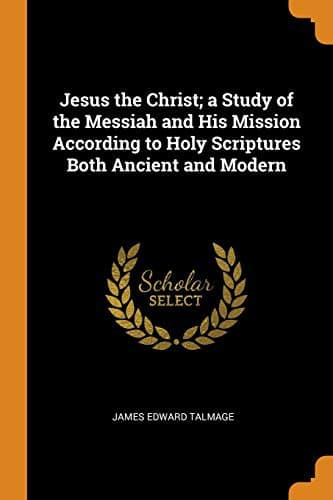
Jesus the Christ: A Study of the Messiah and His Mission According to Holy; Scriptures Both Ancient and ModernTalmage, James E. (James Edward)
Religion
Jesus the Christ: A Study of the Messiah and His Mission According to Holy; Scriptures Both Ancient and Modern
Talmage, James E. (James Edward)
Christian biography -- Palestine; Jesus Christ -- Biography; Jesus Christ -- Mormon interpretations
In all the persecutions waged by His implacable haters, in all the false
accusations brought against Him, in the specific charges of sacrilege
and blasphemy based on His acknowledgment of the Messiahship as His own,
no mention is found of even an insinuation that He could not be the
Christ through any ineligibility based on lineage. Genealogy was
assiduously cared for by the Jews before, during, and after the time of
Christ; indeed their national history was largely genealogical record;
and any possibility of denying the Christ because of unattested descent
would have been used to the fullest extent by insistent Pharisee,
learned scribe, haughty rabbi, and aristocratic Sadducee.
At the time of the Savior's birth, Israel was ruled by alien monarchs.
The rights of the royal Davidic family were unrecognized; and the ruler
of the Jews was an appointee of Rome. Had Judah been a free and
independent nation, ruled by her rightful sovereign, Joseph the
carpenter would have been her crowned king; and his lawful successor to
the throne would have been Jesus of Nazareth, the King of the Jews.
Gabriel's annunciation to Mary was that of the Son of David, on whose
coming the hope of Israel rested as on a sure foundation. The One, thus
announced, was Emmanuel, even God who was to dwell in flesh with His
people,[215] the Redeemer of the world, Jesus the Christ.
NOTES TO CHAPTER 7.
1. John the Baptist Regarded as a Nazarite.--The instruction of the
angel Gabriel to Zacharias, that the promised son, John, was to "drink
neither wine nor strong drink," and the adult life of John as a dweller
in the desert, together with his habit of wearing rough garb, have led
commentators and Biblical specialists to assume that he was a "Nazarite
for life." It is to be remembered, however, that nowhere in scripture
extant is John the Baptist definitely called a Nazarite. A Nazarite, the
name signifying _consecrated_ or _separated_, was one, who by personal
vow or by that made for him by his parents, was set apart to some
special labor or course of life involving self denial. (See page 67).
Smith's _Comp. Dict, of the Bible_ says: "There is no notice in the
Pentateuch of Nazarites for life; but the regulations for the vow of a
Nazarite of days are given (Numb. 6:1-2). The Nazarite, during the term
of his consecration, was bound to abstain from wine, grapes, and every
production of the vine, and from every kind of intoxicating drink. He
was forbidden to cut the hair of his head, or to approach any dead body,
even that of his nearest relation." The sole instance of a Nazarite for
life named in the scriptures is that of Samson, whose mother was
required to put herself under Nazarite observances prior to his birth,
and the child was to be a Nazarite to God from his birth (Judges 13:3-7,
14). In the strictness of his life, John the Baptist is to be credited
with all the personal discipline required of Nazarites whether he was
under voluntary or parental vows or was not so bound.
Public-domain text, read in full here on John Shaqi.
Reviews
Reviews
No reviews yet
Be the first to share your thoughts on this work.
Elsewhere in the archive
Join the Discussion
Join the discussion
Sign in to leave a comment or review.
Sign InorCreate an account