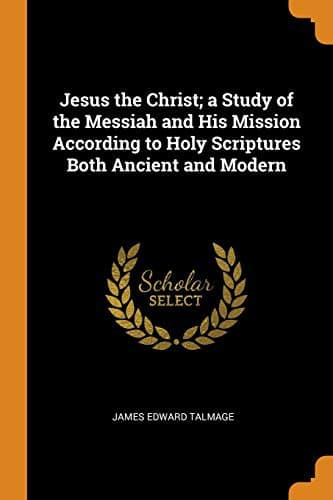
Jesus the Christ: A Study of the Messiah and His Mission According to Holy; Scriptures Both Ancient and ModernTalmage, James E. (James Edward)
Religion
Jesus the Christ: A Study of the Messiah and His Mission According to Holy; Scriptures Both Ancient and Modern
Talmage, James E. (James Edward)
Christian biography -- Palestine; Jesus Christ -- Biography; Jesus Christ -- Mormon interpretations
2. Circumcision, while not exclusively a Hebrew or an Israelitish
practise, was made a definite requirement through the revelations of God
to Abraham, as the sign of the covenant between Jehovah and the
patriarch. (Gen. 17:9-14.) This covenant was made to include the
establishment of Abraham's posterity as a great nation, and provided
that through his descendants should all nations of the earth be blessed
(Gen. 22:18)--a promise which has been proved to mean that through that
lineage should the Messiah be born. Circumcision was a binding
condition; and its practise therefore became a national characteristic.
Every male was to be circumcized eight days after birth (Gen. 17:12;
Lev. 12:3). This requirement as to age came to be so rigidly enforced,
that even if the eighth day fell on a Sabbath the rite had to be
performed on that day (John 7:22, 23). All male slaves had to be
circumcized (Gen. 17:12, 13) and even strangers who sojourned with the
Hebrews and desired to partake of the Passover with them had to submit
to the requirement (Exo. 12:48). From the _Standard Bible Dictionary_ we
take the following: "The ceremony indicated the casting off of
uncleanness as a preparation for entrance into the privileges of
membership in Israel. In the New Testament, with its transfer of
emphasis from the external and formal to the inner and spiritual side of
things, it was first declared unnecessary for Gentile converts to the
gospel to be circumcized (Acts 15:28), and afterward the rite was set
aside even by Jewish Christians." It became customary to name a child at
the time it was circumcized, as is instanced in the case of John, son of
Zacharias (Luke 1:59).
3. Zacharias' Affliction.--The sign for which Zacharias asked was thus
given by the angel: "Behold, thou shalt be dumb, and not able to speak,
until the day that these things shall be performed, because thou
believest not my words, which shall be fulfilled in their season." (Luke
1:20.) From the account of the circumcision and naming of the boy, John,
it is held by some that the afflicted father was also deaf, as the
company "made signs" to him as to how he would have his son named (verse
62).
Public-domain text, read in full here on John Shaqi.
Reviews
Reviews
No reviews yet
Be the first to share your thoughts on this work.
Elsewhere in the archive
Join the Discussion
Join the discussion
Sign in to leave a comment or review.
Sign InorCreate an account