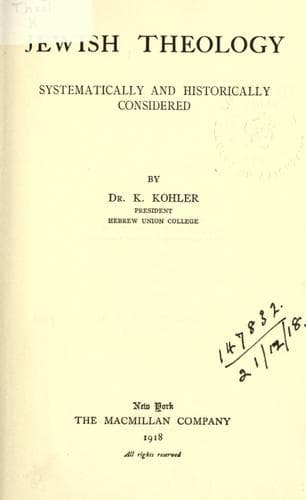
Jewish Theology, Systematically and Historically ConsideredKohler, Kaufmann
Religion
Jewish Theology, Systematically and Historically Considered
Kohler, Kaufmann
Judaism -- Doctrines
1. The great advantage of Judaism over other religious systems lies in its
unified view of life, which it regards as a continuous conflict between
good and evil influences within man. As man succeeds in overcoming evil
and achieving good, he asserts his own moral personality. Outside of man
Judaism sees no real contrast between good and evil, since both have
emanated from God, the Spirit of goodness. Judaism recognizes no primal
power of evil plotting against God and defying Him, such as that of the
Persian dualism. Nor does Judaism espouse the dualism of spirit and
matter, identifying matter with evil, from which the soul strives to free
itself while confined in the prison house of the body. Such a conception
is taught by Plato, probably under Oriental influence, and is shared by
the Hindu and Christian ascetics who torture themselves in order to
suppress bodily desire in their quest of a higher existence. The Jewish
conception of the unity of God necessitates the unity of the world, which
leaves no place for a cosmic principle of evil. In this Judaism dissents
from modern philosophers also, such as John Stuart Mill and even Kant, who
speak of a radical evil in nature. No power of evil can exist in
independence of God.(557) As the Psalmist says: “His kingdom ruleth over
all. Bless the Lord, ye angels of His, ye mighty in strength that fulfill
His word, hearkening unto the voice of His word.”(558)
This increased the difficulty of the problem of the origin of evil. The
answer given by the general Jewish consciousness, expressed by both
Biblical and rabbinical writers, is that evil comes from the free will of
man, who is endowed with the power of rebelling against the will of God.
This idea is symbolized in the story of the fall of man. The serpent, or
tempter, represents the evil inclination which arises in man with his
first consciousness of freedom. So in Jewish belief Satan, the Adversary,
is only an allegorical figure, representing the evil of the world, both
physical and moral. He was sent by God to test man for his own good, to
develop him morally. He is “the spirit that ever wills evil, but achieves
the good,” and therefore in the book of Job he actually comes before God’s
throne as one of the angels.(559)
Public-domain text, read in full here on John Shaqi.
Reviews
Reviews
No reviews yet
Be the first to share your thoughts on this work.
Elsewhere in the archive
Join the Discussion
Join the discussion
Sign in to leave a comment or review.
Sign InorCreate an account