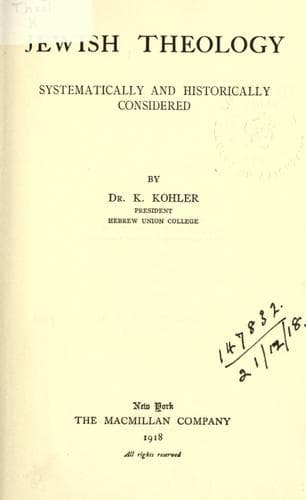
Jewish Theology, Systematically and Historically ConsideredKohler, Kaufmann
Religion
Jewish Theology, Systematically and Historically Considered
Kohler, Kaufmann
Judaism -- Doctrines
2. In tracing the belief in demons we must draw a sharp distinction
between popular views and systematic doctrine.(560) During the Biblical
era the people believed in goat-like spirits roaming the fields and woods,
the deserts and ravines, whom they called _Seirim_—hairy demons, or
satyrs,—and to whom they sacrificed in fear and trembling.(561) As Ibn
Ezra ingeniously pointed out in his commentary, Azazel was originally a
desert demon dwelling in the ravines near Jerusalem, to whom a scapegoat
was offered at the opening of the year, a rite preserved in the Day of
Atonement cult of the Mosaic Code.(562) In fact, in ancient Babylon,
Syria, and Palestine diseases and accidents were universally ascribed to
evil spirits of the wilderness or the nether world. The Bible occasionally
mentions these evil spirits as punitive angels sent by God. In the more
popular view, which is reflected by apocryphal and rabbinical literature,
and which was influenced by both the Babylonian and Persian religions,
they appear in increasing numbers and with specific names. Each disease
had its peculiar demon. Desolate places, cemeteries, and the darkness of
night were all peopled by superstition with hosts of demons (_Shedim_), at
whose head was _Azazel_, _Samael_; _Beelzebub_, the Philistine god of
flies and of illness;(563) _Belial_, king of the nether world;(564) or the
Persian _Ashma Deva_ (Evil Spirit), under the Hebrew name of _Ashmodai_ or
_Shemachzai_.(565) The queen of the demons was _Lilith_ or _Iggereth bath
Mahlath_, “the dancer on the housetops.”(566)
The Essenes seem to have made special studies of both demonology and
angelology, believing that they could invoke the good spirits and conjure
the evil ones, thus curing various diseases, which they ascribed to
possession by demons. While these exorcisms are not so common in the
Talmud as they are in the New Testament, there remain many indications
that such practices were followed by Jewish saints and believed by the
people. Often the rabbis seem to have considered them the work of “unclean
spirits,” which they endeavored to overcome with the “spirit of holiness,”
and particularly by the study of the Torah.(567)
Public-domain text, read in full here on John Shaqi.
Reviews
Reviews
No reviews yet
Be the first to share your thoughts on this work.
Elsewhere in the archive
Join the Discussion
Join the discussion
Sign in to leave a comment or review.
Sign InorCreate an account