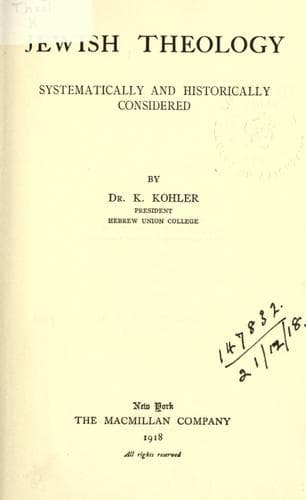
Jewish Theology, Systematically and Historically ConsideredKohler, Kaufmann
Religion
Jewish Theology, Systematically and Historically Considered
Kohler, Kaufmann
Judaism -- Doctrines
6. This sound view was disseminated by the rationalistic school in its
contest with the Cabbalah, and has exerted a wholesome influence upon
modern Judaism. Thus Satan is rejected by Jewish doctrine, while Luther
and Calvin, the Reformers of the Christian Church, still believed in him.
Milton’s “Paradise Lost” placed him in the very foreground of Christian
belief, and the leaders of the Protestant Churches, up to the present,
accord him a prominent place in their scheme of salvation, as the opponent
and counterpart of God. In his work on Christian dogmatics, David
Friedrich Strauss observes acutely: “The whole (Christian) idea of the
Messiah and his kingdom must necessarily have as its counterpart a kingdom
of demons with a personal ruler at its head; without this it is no more
possible than the north pole of the magnet would be without a south pole.
If Christ has come to destroy the works of the Devil, there would be no
need for him to come, unless there were a Devil. On the other hand, if the
Devil is to be considered merely the personification of evil, then a
Christ who would be only the personification of the ideal, but not a real
personality, would suffice equally.”(587) At present Christian theologians
and even philosophers have recourse to Platonic and Buddhist ideas, that
evil is implanted in the world from which humanity must free itself, and
they thus present Christianity as the _religion of redemption par
excellence_.(588) Over against this, Judaism still maintains that there is
no radical or primitive evil in the world. No power exists which is
intrinsically hostile to God, and from which man must be redeemed.
According to the Jewish conception, the goodness and glory of God fill
both heaven and earth, while holiness penetrates all of life, bringing
matter and flesh within the realm of the divine. Evil is but the contrast
of good, as shade is but the contrast of light. Evil can be overcome by
each individual, as he realizes his own solemn duty and the divine will.
Its only existence is in the field of morality, where it is a test of
man’s freedom and power. Evil is within man, and against it he is to wage
the battles of life, until his victory signalizes the triumph of the
divine in his own nature.(589)
Chapter XXXII. God and the Intermediary Powers
Public-domain text, read in full here on John Shaqi.
Reviews
Reviews
No reviews yet
Be the first to share your thoughts on this work.
Elsewhere in the archive
Join the Discussion
Join the discussion
Sign in to leave a comment or review.
Sign InorCreate an account