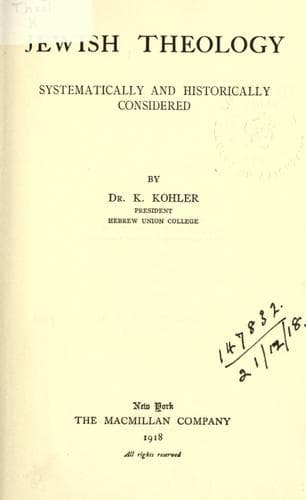
Jewish Theology, Systematically and Historically ConsideredKohler, Kaufmann
Religion
Jewish Theology, Systematically and Historically Considered
Kohler, Kaufmann
Judaism -- Doctrines
The Serpent in the Paradise story is more completely a demon, although the
legend intends rather to account for man’s morality, his distinction
between good and evil. Satan was then identified with the serpent, who was
called by the rabbis _Nahash ha Kadmoni_, “the primeval Serpent,” after
the analogy of the serpent-like form of Ahriman. Thus Satan in the person
of the serpent became the embodiment of evil, the prime cause of sin and
death.(577) Possibly a part in this process was played by the Babylonian
figure of _Tihamat_, the dragon of _chaos_ (_Tehom_ in the Hebrew), with
whom the god Marduk wrestled for dominion over the world, and who has
parallels in the Biblical Rahab and similar mythological figures.
We must not overlook such rabbinical legends as the one about how the
poisonous breath of the serpent infected the whole human race, except
Israel who has been saved by the law at Sinai.(578) Occasionally we hear
that the Evil Spirit (_Yezer ha Ra_) will be slain by God(579) or by the
Messiah.(580) These Haggadic sayings, however, were never accepted as
normative for religious belief. On the contrary, they were always in
dispute, and many a Talmudic teacher minimized the fiendish character of
Satan, who became a stimulus to moral betterment through the trials he
imposes.(581) Philo, allegorizing the legends, turns the evil angels of
the Bible into wicked men.(582)
5. As to demons in general, the Talmudists never doubted their existence,
but endeavored to minimize their importance. They changed the demon
_Azazel_ into a geographical term by transposing the letters.(583) They
explained “the sons of God who came to the daughters of men to give birth
to the giants of old” as aristocratic Sethites who intermarried with
low-class families of the Cainites.(584) As to the rest, the entire belief
in demons and ghosts was too deeply rooted in the folk mind to be
counteracted by the rabbis. Even lucid thinkers of the Middle Ages were
caught by these baneful superstitions, including Jehuda ha Levi, Crescas,
and Nahmanides, the mystic.(585) Only a small group fought against this
offshoot of fear and superstition, among them Saadia, Maimonides and his
school, Ibn Ezra, Gersonides, and Juda Ibn Balag. To Maimonides the demons
mentioned in Mishnah and Talmud are only figurative expressions for
physical plagues. He considers the belief in demons equivalent to a belief
in pagan deities. “Many pious Israelites,” he says,(586) “believe in the
reality of demons and witches, thinking that they should not be made the
object of worship and regard, for the reason that the Torah has prohibited
it. But they fail to see that the Law commands us to banish all these
things from sight, because they are but falsehood and deceit, as is the
whole idolatry with which they are intrinsically connected.”
Public-domain text, read in full here on John Shaqi.
Reviews
Reviews
No reviews yet
Be the first to share your thoughts on this work.
Elsewhere in the archive
Join the Discussion
Join the discussion
Sign in to leave a comment or review.
Sign InorCreate an account