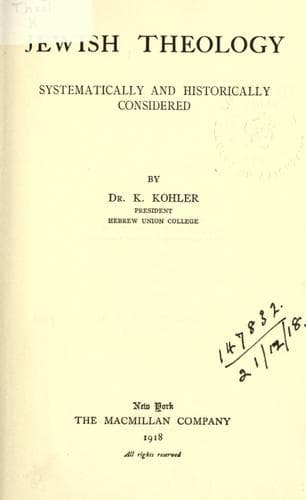
Jewish Theology, Systematically and Historically ConsideredKohler, Kaufmann
Religion
Jewish Theology, Systematically and Historically Considered
Kohler, Kaufmann
Judaism -- Doctrines
5. While it is man’s spiritual side which is the image of God, yet he
derives all his powers and faculties from earthly life, just as a tree
draws its strength from the soil in which it is rooted. Judaism does not
consider the soul the exclusive seat of the divine, as opposed to the
body. In fact, Judaism admits no complete dualism of spirit and matter,
however striking some aspects of their contrast may be. The whole human
personality is divine, just so far as it asserts its freedom and molds its
motives toward a divine end. In recognition of this fact Hillel claimed
reverence for the human body as well as mind, comparing it to the homage
rendered to the statue of a king, for man is made in the image of God, the
King of all the world.(634) Thus the Greek idea that man is a _microcosm_,
a world in miniature, reflecting the cosmos on a smaller scale, was
expressed in the Tannaitic schools as well.(635) The stamp of divinity is
borne by man in his entire heaven-aspiring nature, as he strives to
elevate the very realm of the senses into the sphere of morality and
holiness.
6. In this respect the Jewish view parts from that of Plato and the Hindu
philosophers. These divide man into a pure celestial soul and an impure
earthly body and hold that the physical life is tainted by sin, while the
spirit is divine only in so far as it frees itself from its prison house
of flesh. Judaism, on the other hand, emphasizes the unified character of
man, by which he can bend all his faculties and functions to a godlike
mastery over the material world. This appears first in his upright posture
and heavenward glance, which proclaim him master over the whole animal
world cowering before him in lowly dread. His whole bodily structure
corresponds to this, with its constant growth, its wondrous symmetry, and
the unique flexibility of the hands, with which he can perform ever new
and greater achievements. Above all, we see the nobility of man in his
high forehead and receding jaw, which contrast so strikingly with the
structure of most animals and even with many of the lower races. Indeed,
primitive man could scarcely imagine a nobler pattern by which to model
his deity than the figure of a man.
Public-domain text, read in full here on John Shaqi.
Reviews
Reviews
No reviews yet
Be the first to share your thoughts on this work.
Elsewhere in the archive
Join the Discussion
Join the discussion
Sign in to leave a comment or review.
Sign InorCreate an account