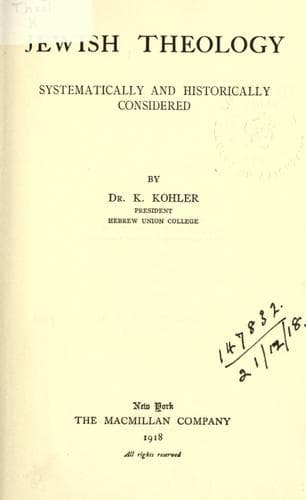
Jewish Theology, Systematically and Historically ConsideredKohler, Kaufmann
Religion
Jewish Theology, Systematically and Historically Considered
Kohler, Kaufmann
Judaism -- Doctrines
3. According to the Haggadists,(629) before the fall man excelled even the
angels in appearance and wisdom, so that they were ready to prostrate
themselves before him. Only when God caused a deep sleep to fall upon man,
they recognized his frailty and kinship with other beings of the earth.
The idea expressed in this legend resembles the one implied in the legend
of Paradise, viz. man has a twofold nature. With his heavenly spirit he
can soar freely to the highest realm of thought, above the station of the
angels; yet his earthly frame holds him ever near the dust. It is this
very contrast that constitutes his greatness, for it makes him a citizen
of two worlds, one perishable, the other eternal. He is the highest result
of Creation, the pride of the Creator.(630) Thus he was appointed God’s
vice-regent on earth by the words spoken to the first man and woman: “Be
fruitful, and multiply, and replenish the earth, and subdue it; and have
dominion over the fish of the sea, and over the fowl of the air, and over
every living thing that creepeth upon the earth.”(631) The rabbis add a
striking comment upon the word _R’du_, which is used here for “have
dominion” but which may also mean, “go down.” They say: “The choice is
left in man’s own hand. If you maintain your heaven-born dignity, you will
have dominion over all things; if not, you will descend to the level of
the brute creation.”(632)
4. An ancient Mishnah derives a significant lesson from the story of the
creation of man(633): “Both the vegetable and animal worlds were created
in multitudes. Man alone was created as a single individual in order that
he may realize that he constitutes a world in himself, and carries within
him the true value of life. Hence each human being is entitled to say:
‘The whole world was created for my sake.’ He who saves a single human
life is as one who saves a whole world, and he who destroys a single human
life is as one who destroys a whole world.”
Public-domain text, read in full here on John Shaqi.
Reviews
Reviews
No reviews yet
Be the first to share your thoughts on this work.
Elsewhere in the archive
Join the Discussion
Join the discussion
Sign in to leave a comment or review.
Sign InorCreate an account