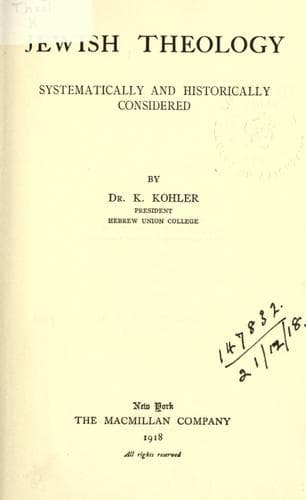
Jewish Theology, Systematically and Historically ConsideredKohler, Kaufmann
Religion
Jewish Theology, Systematically and Historically Considered
Kohler, Kaufmann
Judaism -- Doctrines
However, rabbinical Judaism never followed Philo so far in the footsteps
of Plato as to consider the body or the flesh the source of impurity and
sin, or “the prison house of the soul.” This view is fundamental in the
Paulinian system of other-worldliness. For the rabbis the sensuous desire
of the body (_yezer_) is a tendency toward sin, but never a compulsion.
The weakness of the flesh may cause a straying from the right path, but
man can turn the desires of the flesh into the service of the good. He can
always assert his divine power of freedom by opposing the evil inclination
(_yezer ha ra_) with the good inclination (_yezer ha tob_) to overcome
it.(650) In fact, the rabbis are so far from acknowledging the existence
of a compulsion of evil in the flesh, that they point to the history of
great men as proof that the highest characters have the mightiest passions
in their souls, and that their greatness consists in the will by which
they have learned to control themselves.(651)
5. In the light of modern science the whole theory separating body and
soul falls to the ground, and the one connecting man more closely with the
animal world is revived. In this connection we think of the idea which
medieval thinkers adopted from Plato and Aristotle, that there is a
substance of souls—_nefesh hahiyonith_—which forms the basic life-force of
men and animals. Physiology and psychology reveal the interaction and
dependence of body and soul in the lowest forms of animal life as well as
in the higher forms, including man. The beginnings of the human mind must
be sought once for all in the animal, just as the origin of the animal
reaches back into the plant world. Indeed, Aristotle anticipates the
discoveries of modern science, placing the vegetative and animal souls
beside the spirit of man. Thus motion and sensibility form the lower
boundary-line of the animal kingdom, and self-consciousness and
self-determination are the criteria of humanity.
Yet this very self-conscious freedom which forms man’s personality, his
_ego_, lifts him into a realm of free action under higher motives,
transcending nature’s law of necessity, and therefore not falling within
the domain of natural science. Dust-born man, notwithstanding his earthly
limitations, in spite of his kinship to mollusk and mammal, enters the
realm of the divine spirit. In the Midrash the rabbis remark that man
shares the nature of both animals and angels.(652) Admitting this, we feel
that he is tied neither to heaven nor to the earth, but free to lift
himself above all creatures or sink below them all.
Public-domain text, read in full here on John Shaqi.
Reviews
Reviews
No reviews yet
Be the first to share your thoughts on this work.
Elsewhere in the archive
Join the Discussion
Join the discussion
Sign in to leave a comment or review.
Sign InorCreate an account