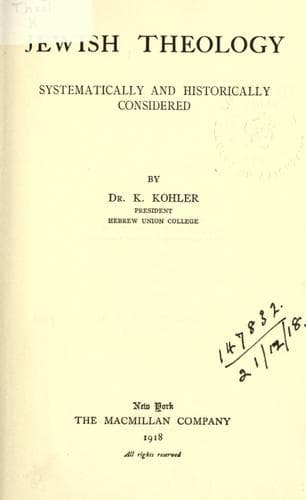
Jewish Theology, Systematically and Historically ConsideredKohler, Kaufmann
Religion
Jewish Theology, Systematically and Historically Considered
Kohler, Kaufmann
Judaism -- Doctrines
6. Endowed with this dual nature, man stands in the very center of the
universe, and God esteems him “equal in value to the entire creation,” as
Rabbi Nehemiah says of a single human soul.(653) Rabbi Akiba stresses the
image of God in humanity when he says: “Beloved is man, for he is created
in God’s image, and it was a special token of love that he became
conscious of it. Beloved is Israel, for they are called the children of
God, and it was a special token of love that they became conscious of
it.”(654) The Midrash compares man to God in exquisite manner: “Just as
God permeates the world and carries it, unseen yet seeing all, enthroned
within as the Only One, the Perfect, and the Pure, yet never to be reached
or found out; so the soul penetrates and carries the body, as the _one_
pure and luminous being which sees and holds all things, while itself
unseen and unreached.”(655) The conception of the soul is here divested of
every sensory attribute, and portrayed as a divine force within the body.
This conception, which was accepted by the medieval philosophers, is
thoroughly consistent with our view of the world. The soul it is which
mirrors both the material and spiritual worlds and holds them in mutual
relation through its own power. It is at the same time swayed upward and
downward by its various cravings, heavenly and earthly, and this very
tension constitutes the dual nature of the human soul.
Chapter XXXV. The Origin and Destiny of Man
1. Of all created beings man alone possesses the power of
self-determination; he assigns his destiny to himself. While he endeavors
to find the object of all other things and even of his own existence in
the world, he finds his own purpose within himself. Star and stone, plant
and beast fulfill their purpose in the whole plan of creation by their
existence and varied natures, and are accordingly called “good” as they
are. Man, however, realizes that he must accomplish his purpose by his
manner of life and the voluntary exertion of his own powers. He is “good”
only as far as he fulfills his destiny on earth. He is not good by mere
existence, but by his conduct. Not what he is, but what he ought to be
gives value to his being. He is good or bad according to the direction of
his will and acts by the imperative: “I ought” or “I ought not,” which
comes to him in his conscience, the voice of God calling to his soul.
Public-domain text, read in full here on John Shaqi.
Reviews
Reviews
No reviews yet
Be the first to share your thoughts on this work.
Elsewhere in the archive
Join the Discussion
Join the discussion
Sign in to leave a comment or review.
Sign InorCreate an account